Barndominium Builders in Warren County, KY
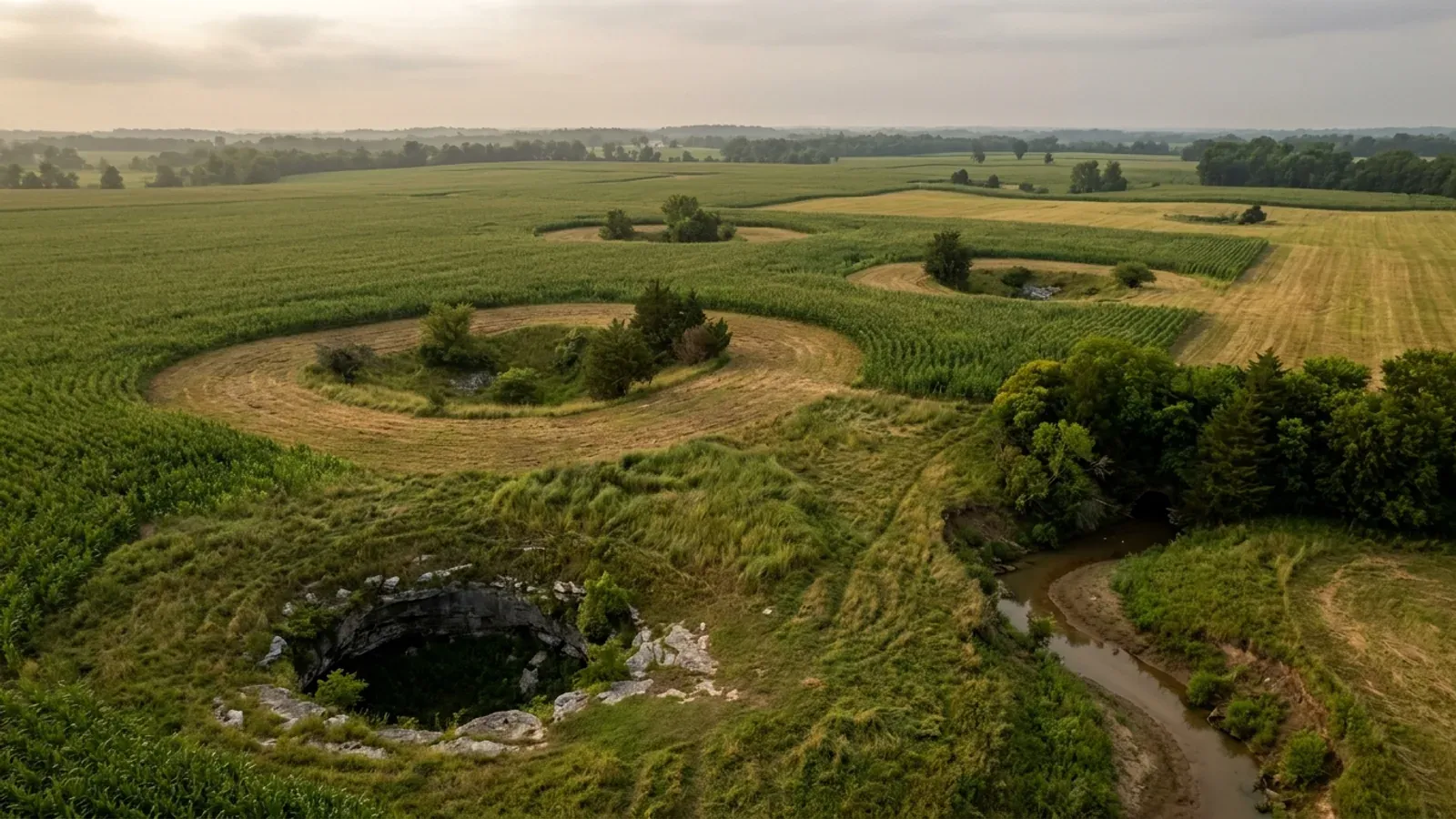
Warren County is the heart of Kentucky sinkhole country, and on this ground the foundation is the story. The Kentucky Geological Survey puts Bowling Green inside the Western Pennyroyal — the largest of its named karst areas and the one KGS says holds the state's longest caves and its densest sinkhole development. That matters more here than anywhere else on this site, because KGS's own model karst ordinance, Information Circular 25, lists the structures that should not be sited in a sinkhole area with a history of cover collapse, and the first two entries on that list are buildings with soil-bearing foundations and buildings covering thousands of square feet with impermeable surface. A post-frame or steel building on a monolithic slab is both at once. IC-25 is a model rather than a law, and the same document says nearly all karst parcels still have buildable ground on them — so the answer is not to avoid Warren County, it is to stop siting the pad by eye. Warren is also the rare Kentucky county that regulates. The Division for Building Services enforces the Kentucky Building and Residential Codes county-wide outside Bowling Green and Oakland, permits are priced at fifteen cents a square foot, the Bowling Green–Warren County Contractors Licensing Board licences the builder, the joint zoning ordinance sets a five-acre agricultural minimum and names karst in the district's own purpose clause, and the Fiscal Court carries a Sinkhole Filling Ordinance. Almost none of that is true of the counties on either side.
Warren County at a glance
- County
- Warren
- Population
- 152,184
- ZIP codes
- 42101, 42102, 42103, 42104, 42122, 42159, 42170, 42171, 42274
- Site visits
- Site visits across the Barren River valley and the Pennyroyal — Warren, Barren, Allen and Edmonson
Building conditions in Warren County
The building code is the same in every Kentucky county, and no local government may adopt or enforce a different one on a house — the Kentucky Residential Code says so in its own text. The design criteria are settled by the state too: the code prints a filled-in table covering all 120 counties, so your county's ground snow load, frost depth and seismic design category are published figures rather than something a local office decides. Ultimate design wind speed is 115 mph for every county in the state.
What changes from one county to the next is whether anyone checks. Kentucky makes permits, inspections and certificates of occupancy optional for a single-family home unless the local government has passed an ordinance requiring them, and it forbids the state from stepping in where none has. Twenty-five counties tell the state outright that they have no local building inspector, and in much of the rest the answer depends on an ordinance the county either passed or never did. Zoning is a separate, equally local choice — most Kentucky counties have never adopted any. What is below covers this county specifically: who issues the permit if anyone does, what the state's tables assign it, and what the ground does to a slab.
https://www.warrencountyky.gov/departments/public-works/building-services/ (Warren County Government's own department page, read 6 Sep 2026 — the host sits behind Cloudflare and refuses plain automated requests, so the page was read through WebFetch rather than a direct download) · https://www.warrencountyky.gov/departments/public-works/code-enforcement/ · https://dhbc.ky.gov/Documents/Warren%20County.pdf (DHBC county sheet updated 5/5/2026, text extracted and read 6 Sep 2026 — a contact directory, not an ordinance register) · https://apps.legislature.ky.gov/law/statutes/statute.aspx?id=52659
https://kgs.uky.edu/kygeode/geomap?gkarst=true (KGS Karst Potential Index viewer — deep link with the karst layer switched on; loaded and confirmed live 6 Sep 2026, HTTP 200, interactive map application) · https://kgs.uky.edu/kgsmap/helpfiles/karst_help.shtm (the three KPI classes and how they are derived) · https://www.uky.edu/KGS/water/library/gwatlas/wprkarst.html · https://www.uky.edu/KGS/karst/karst_location.php · https://kgs.uky.edu/arcgis/rest/services/GeologicMapData/KY500KKarstPotential_WGS84/MapServer/0 (service confirmed live) · https://kgs.uky.edu/kgsweb/download/geology/karst500k.zip · https://www.uky.edu/KGS/karst/karst_resources.php
https://kgs.uky.edu/kgsweb/olops/pub/kgs/IC25_12.pdf (Currens, J.C., 2012, KGS Information Circular 25, Series XII — §§ 1.21, 1.24, 1.34, 4.12, 4.13, 4.21, 4.53, 5.01, 5.20, 5.51, 6.41-6.43; full text extracted and read, transcribed in research/statewide/soils-karst-and-slopes.md) · https://www.warrencountyky.gov/departments/fiscal-court/ordinances/ (Fiscal Court ordinance index listing 82-54-WC Sinkhole Filling Ordinance) · https://www.warrencountyky.gov/departments/stormwater-management/ · https://www.warrencountyky.gov/wp-content/uploads/2023/06/pw-ordinance-WC-82-54-Sinkhole-Filling.pdf (downloaded 6 Sep 2026 — a one-page scan with no extractable text layer) · https://www.warrenpc.org/wp-content/uploads/2021/03/Article-4_April2021.pdf (Sec. 4.3.1.G, karst named in the AG district purpose clause; text extracted and read)
https://www.bgky.org/contractorslicensing/info (fees, jurisdiction, $100,000 general liability and certificate-holder requirement, workers' comp and the two occupational licences — read 6 Sep 2026) · https://www.bgky.org/contractorslicensing/faq · https://www.bgky.org/contractorslicensing · https://www.warrencountyky.gov/departments/public-works/building-services/ · corroborated in research/statewide/contractor-licensing.md § 3.3
https://www.warrenpc.org/wp-content/uploads/2021/03/Article-4_April2021.pdf (Sec. 4.3 Agriculture District dimensional table and Sec. 4.4.5.E accessory-structure standards — text extracted and read 6 Sep 2026; cross-checked against the earlier https://www.warrenpc.org/wp-content/uploads/2020/11/Article-4_December2019.pdf, which carries the same figures) · https://www.warrenpc.org/regulations-documents/ (the Commission now serves current articles from Google Drive, so confirm the live text with the Planning Commission on 270-842-1953) · KRS Chapter 100, https://apps.legislature.ky.gov/law/statutes/chapter.aspx?id=38316
https://dhbc.ky.gov/Documents/2018%20Kentucky%20Residential%20Code%203d%20Ed.pdf — Table R301.2(1) (ground snow, ultimate wind, weathering, termite), Table R301.2.2.1 Seismic Design Categories–Site Class D, Table R403.1.4 Minimum Frost Protection Depth for Kentucky; all three transcribed county-by-county in research/statewide/design-criteria-and-climate.md
Also worth knowing before you build in Warren County
- Septic on karst: 70 feet from a sinkhole throat, and everything downslope of the sideslope midpoint, is unsuitable
- The Barren River District Health Department issues the on-site sewage permit for Warren County, one of eight counties it covers along with Barren, Butler, Edmonson, Hart, Logan, Metcalfe and Simpson; the Warren County office is at 1109 State Street in Bowling Green, 270-781-2490. The district evaluates the soil on site, reviews the installation drawing before issuing a permit, and inspects the installed system. What decides a Warren County parcel is Kentucky's on-site sewage regulation, 902 KAR 10:085, and its karst clause is unusually blunt: an area closer than seventy feet to an open sinkhole throat, downslope from the sinkhole sideslope midpoint, or subject to flooding damage shall be considered unsuitable. Read that as three separate disqualifiers rather than one. The seventy-foot rule is a fixed radius and easy to plan around. The downslope-of-the-sideslope-midpoint rule is not a radius at all — on a large, shallow Pennyroyal sinkhole it can sterilise a very large share of a parcel, and it is geometry a buyer standing in a hayfield will not see. In the densest sinkhole terrain in Kentucky, the sinkhole map decides where the septic field goes, the septic field decides where the house goes, and the building plan comes third. Get the site evaluation before the deed, not after.
- Dig out a sinkhole throat or drop in a dry well and you have built a Class V injection well — and the regulator is EPA, not Frankfort
- Warren County's own subdivision stormwater guide is unusually candid about the mechanism: in Warren County the karst cave system has been used, often overly so, to manage stormwater runoff; predicting the pathways of underground streams is not an exact science; the system has limits, which show up as basins that will not drain or that surcharge when the cave is full; and lawn chemicals travel straight into drywells and sinkhole boxes with no treatment and on into the groundwater. The City of Bowling Green says the same thing from the regulatory side — its dry wells are Class V injection wells under EPA rules, and Class V wells must be reported to EPA as well as to the city on its own reporting form. That is the point most rural buyers miss. KGS's IC-25 § 5.51 states that increasing a sinkhole's recharge rate by excavating the throat or installing dry wells classifies the modified sinkhole as a Class V injection well, and Kentucky's EPA-approved underground injection control primacy covers Class II wells only — approved effective 21 March 2017 and excluding Classes I, III, IV, V and VI. Class V wells in Kentucky are therefore implemented directly by EPA Region 4. Inventory information goes to the UIC director before construction begins. A barndominium is a point source by existing: several thousand square feet of metal roof plus a gravel apron and a long drive converts a diffuse vegetated recharge area into concentrated discharge, which is exactly the trigger KGS and USGS both name for new sinkhole formation. Route the roof water away from any closed depression, and never make water disappear faster by opening the throat.
- CRS Class 7 — Warren County flood insurance carries a 15 percent discount, and flooding here comes up as well as down
- FEMA's Community Status Book for Kentucky lists unincorporated Warren County (CID 210312) and the City of Bowling Green (CID 210219) as participating in the National Flood Insurance Program, the county with an initial FIRM of 19 November 1980 and the city from 1 August 1980, both on a current effective map dated 2 May 2007, and both carrying Community Rating System Class 7 — a 15 percent premium discount for policyholders. That discount is earned by floodplain management the community does above the NFIP minimum, and it is rare enough in Kentucky to be worth naming. The City-County Planning Commission administers the floodplain program for the county and the city together, with Jacob Merriman as Local Floodplain Manager (270-842-1953), and it describes the local flood mechanism precisely: river and creek flooding, flash flooding from interior streams, and flooding from overloaded storm and karst systems. The last of those is the Warren County signature. Sinkhole flooding is not water rising in the Barren River — it is water coming back up out of the ground in a closed depression a mile from any stream, when the cave system below is already full, and the FIRM does not always show it. The county's own zoning ordinance floodway standards prohibit fill, obstruction or storage that would cause erosion or obstruction of a watercourse, natural drainage crevices, sinkholes, ditches or known subterranean water channels. On top of any local approval, Kentucky requires a separate state Division of Water floodplain construction permit for work in the base floodplain under KRS 151.250 and 401 KAR 4:060 § 2, applied for on form DOW 7116 — the state permit stacks on the local one, it does not replace it.
- Warren lost 13 percent of its farms in five years — the fastest-growing county in Kentucky is eating its own land supply
- USDA's 2022 Census of Agriculture county profile puts Warren at 1,530 farms across 234,924 acres, averaging 154 acres. It is the third-largest farm count in Kentucky. But the direction of travel is the fact that matters to somebody looking for a homesite: the farm count fell 13 percent since 2017 and land in farms fell 10 percent, while average farm size rose 3 percent. Small and mid-size tracts are being absorbed and the survivors are consolidating. The size distribution still favours a barndominium buyer — 642 farms of 10 to 49 acres and 483 of 50 to 179 acres, so the mid-size tract is the ordinary Warren parcel rather than the rare one, and only 138 farms are under 10 acres. Land in farms breaks down as 140,803 acres cropland, 41,164 pastureland and 38,844 woodland, so this is open row-crop and pasture country rather than the wooded ridge ground of the Cumberland counties. Set against that: Warren County grew 13.1 percent between the 2020 census and the 2024 estimates, the fastest of any Kentucky county, Bowling Green is the state's third-largest city, and the county carries 545 square miles at 247 people per square mile. Buildable rural acreage inside a fifteen-minute drive of the city is competitive and getting more so, and the ordinary answer is to look one ring further out — Barren County has the most farms of any county in the state, and Allen and Edmonson sit on the same karst with a fraction of the population pressure.
- Warren is an EPA radon Zone 1 county, and Kentucky's code does not require you to do anything about it
- EPA maps Warren as one of only thirty Kentucky counties in radon Zone 1, its highest predicted indoor radon class. The pattern behind that list is not a coincidence and it is worth saying plainly: Kentucky's Zone 1 map is essentially its karst map — the Inner Bluegrass plus the Pennyroyal karst belt of Warren, Barren, Hart, Allen, Monroe, Metcalfe, Cumberland, Adair, Green, Taylor, Casey, Russell and Pulaski. KGS itself lists radon infiltration into homes as a karst hazard, right beside sinkhole flooding and sudden cover collapse, because the same solution-widened joints that drain a sinkhole also vent soil gas. What Kentucky does not do is regulate it: the Kentucky Residential Code adopts appendices K, R and S and does not adopt Appendix F, Radon Control Methods, so radon-resistant construction is required nowhere in the Commonwealth. On a slab-on-grade building with a large footprint that is a decision worth making deliberately. A passive sub-slab depressurisation rough-in — the gas-permeable layer, the membrane, the tee and the stack — costs very little while the slab is still open and a great deal to retrofit afterwards. KRS 309.436(9) expressly exempts a building contractor installing vent pipes during construction of a home from Kentucky's radon licensing regime, so the rough-in is a builder's ordinary work; the same statute polices the title, so nobody without a mitigation registration should be described as a certified mitigation contractor.
- Warren County's fiscal court voted into the mine subsidence fund in 2009 and the county is not on the current list
- Kentucky's Mine Subsidence Insurance Fund covers counties whose fiscal courts voted the coverage in, and in those counties KRS 304.44-030 puts the endorsement on every property policy automatically unless the insured waives it in writing. There is a wrinkle specific to Warren. Department of Insurance Bulletin 2009-04 announced that the Letcher, Owsley and Warren county fiscal courts had voted to participate, effective for companies no later than 1 March 2010. Letcher and Owsley appear on the Department's current 37-county brochure. Warren does not. Something changed between those two documents, and the right move for a Warren County buyer is to ask the Department of Insurance directly rather than to rely on either list. It matters less than it sounds, because mine subsidence is a coal-field hazard and Warren's ground problem is karst — and Kentucky built a statutory reinsurance fund for underground coal-mine collapse and nothing comparable for sinkholes, even though KGS puts karst geohazard losses at roughly $20 million a year statewide. The standard homeowner's earth-movement exclusion, which the Department quotes in its own mine-subsidence brochure, is broad enough to swallow a karst collapse, and the Kentucky Real Estate Commission's Form 402 seller's disclosure asks about soil stability, drainage and erosion while asking nothing at all about sinkholes, caves or undermining. Sinkhole cover in Kentucky is a voluntary endorsement — put the question to your agent in writing before closing.
- One zoning ordinance, six governments — and Oakland is carved out of the county building program
- Warren County's land-use machinery is jointly run in a way that is unusual even for Kentucky. The zoning ordinance is a single joint ordinance adopted by the Warren County Fiscal Court together with the incorporated cities of Bowling Green, Oakland, Plum Springs, Smiths Grove and Woodburn, administered for all of them by the City-County Planning Commission of Warren County. The contractor licence is issued by a joint Bowling Green–Warren County board covering city and county alike. The floodplain program is run by the Planning Commission for both. Building inspection is the one that is not joint: the county's Division for Building Services covers Warren County excluding Bowling Green and Oakland, Bowling Green runs its own Building Division at 707 E Main Ave, and the City of Oakland is carved out separately. So on a parcel near Oakland, Smiths Grove, Plum Springs or Woodburn, the zoning answer and the permit answer can come from two different desks. Establish which side of each line your parcel sits on before you design anything: the Planning Commission on 270-842-1953 for zoning, the Division for Building Services on 270-843-5360 for the permit, and the city clerk if the address is inside a municipality. Warren County's Code Enforcement Board, which references the 2021 International Property Maintenance Code, enforces county property maintenance, stormwater, building, zoning and contractor licensing requirements outside the Bowling Green city limits.
https://apps.legislature.ky.gov/law/kar/titles/902/010/085/ (902 KAR 10:085, on-site sewage disposal systems — the karst suitability clause, transcribed in research/statewide/land-water-and-septic.md) · https://www.barrenriverhealth.org/services/onsite-sewage (soil evaluation, drawing review, permit and inspection sequence; the eight-county district) · https://www.barrenriverhealth.org/locations/warren-county-health-department · https://dhbc.ky.gov/Documents/Warren%20County.pdf (the DHBC sheet routes the health-department environmentalist row to the Barren River District office at 1109 State St)
https://www.warrenpc.org/wp-content/uploads/2019/08/APPENDIX-B.pdf (Warren County Storm Water Guide, Subdivision Regulations Appendix B, § B.1 — text extracted and read 6 Sep 2026) · https://www.bgky.org/stormwater/quality/post-construction (Bowling Green's own Class V injection well and dry well statement) · https://kgs.uky.edu/kgsweb/olops/pub/kgs/IC25_12.pdf §§ 5.51, 5.01, 5.20, 6.41-6.43 · https://www.federalregister.gov/documents/2016/10/28/2016-25929/commonwealth-of-kentucky-underground-injection-control-uic-class-ii-program-primacy-approval · https://epa.gov/uic/underground-injection-control-epa-region-4-al-fl-ga-ky-ms-nc-sc-and-tn · https://www.usgs.gov/special-topics/water-science-school/science/sinkholes
https://www.fema.gov/cis/KY.html (Kentucky Community Status Book — CIDs, FIRM dates and CRS classes, read 6 Sep 2026) · https://www.warrenpc.org/floodplain/ (Local Floodplain Manager and the three named flood mechanisms) · https://www.warrenpc.org/wp-content/uploads/2021/03/Article-4_April2021.pdf (floodway standards naming sinkholes and subterranean water channels) · https://apps.legislature.ky.gov/law/statutes/statute.aspx?id=54097 · https://eec.ky.gov/Environmental-Protection/Water/FloodDrought/Pages/default.aspx
https://www.nass.usda.gov/Publications/AgCensus/2022/Online_Resources/County_Profiles/Kentucky/cp21227.pdf (2022 Census of Agriculture, Warren County profile, FIPS 21227 — text extracted with pdftotext and read 6 Sep 2026) · population, area and density figures from the county table in research/statewide/geography-and-population.md, sourced to Census PEP county estimates
https://www.epa.gov/sites/default/files/2014-08/documents/kentucky.pdf (EPA Map of Radon Zones, Kentucky — the 30 Zone 1 counties, transcribed in research/statewide/soils-karst-and-slopes.md § 7) · https://www.uky.edu/KGS/water/library/gwatlas/wprkarst.html (KGS listing radon infiltration among karst hazards) · https://kygs.uky.edu/geology/radon · https://dhbc.ky.gov/Documents/2018%20Kentucky%20Residential%20Code%203d%20Ed.pdf (adopted appendices K, R and S)
https://insurance.ky.gov/ppc/Documents/bulletin0904minesubs092109.pdf (Bulletin 2009-04 naming Warren among the fiscal courts voting in) · https://insurance.ky.gov/PPC/Documents/JAN%202025_Revised%20Mine%20Subsidence%20Insurance%20Fund%20080124.pdf (current 37-county brochure, rev. 08/24 eff. 1/1/25, which does not list Warren) · https://krec.ky.gov/Documents/KREC%20Form%20402%20-%20Sellers%20Disclosure%20of%20Property%20Condition.pdf · https://kgs.uky.edu/kgsweb/olops/pub/kgs/IC25_12.pdf § 1.21
https://www.warrenpc.org/regulations-documents/ (the joint ordinance and the six adopting jurisdictions) · https://www.warrencountyky.gov/departments/public-works/building-services/ (the Bowling Green and Oakland exclusions) · https://www.warrencountyky.gov/departments/public-works/code-enforcement/ · https://www.bgky.org/ncs/building · https://www.warrenpc.org/floodplain/
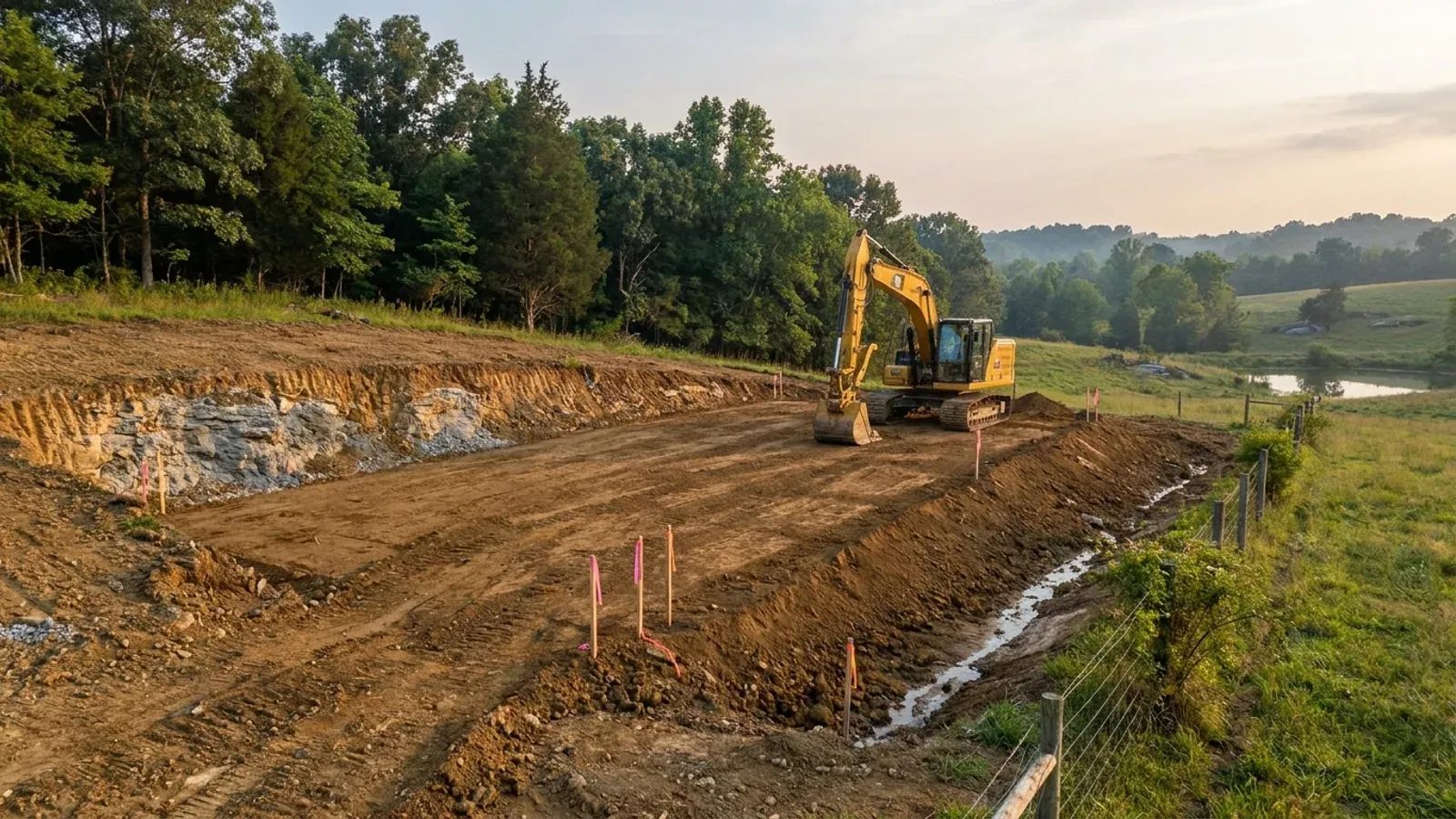
The expensive surprises are in the ground, not the building
What moves a Kentucky budget is usually below grade, and more often than not it is what the ground is sitting on rather than the ground itself. The Kentucky Geological Survey says 92 of the state's 120 counties contain karst — limestone that dissolves — across four named areas: the Western Pennyroyal around Bowling Green and Hopkinsville, the Inner Bluegrass around Lexington, the Eastern Pennyroyal through Somerset and Monticello, and Pine Mountain in the south-east. On karst, KGS's own model ordinance for local governments lists the structures that should not be sited in sinkhole areas, and the list is buildings with soil-bearing foundations and buildings that cover thousands of square feet with impermeable surface. A post-frame or steel building on a monolithic slab is both of those at once. KGS is equally clear that nearly all karst parcels still have buildable ground on them — so karst does not stop the build, it removes the option of siting the pad by eye. A filled and graded-over sinkhole is the classic trap, because the pad looks perfect.
In the two coal fields the question is undermining instead, and Kentucky treats it differently from everything else: mine subsidence coverage is added automatically to property policies in the counties whose fiscal court voted the fund in, with a written opt-out — thirty-seven of them — while karst collapse gets no fund at all and falls under the ordinary earth-movement exclusion. On slopes the surprise is geographic: KGS's landslide inventory puts Kenton, Campbell, Boone and Gallatin — the northern Kentucky counties opposite Cincinnati — near the very top, above most Appalachian counties, on Ordovician shale. Three of those four — Boone, Campbell and Kenton — are the only counties in the state with a line of their own in the residential code's bearing table, which raises the presumptive value for two named clay groups there and nowhere else. Everywhere else the table gives clay and silt a single presumptive figure, and a soils investigation becomes mandatory once the building official determines the real capacity is likely to be lower than it.
The same ground then sizes the septic system, and Kentucky does that from soil morphology — a certified inspector reading the profile in a backhoe pit — rather than from a percolation test, at 110 gallons a day per bedroom against an application rate taken from soil texture and structure. On a mound or other alternative design a measured permeability test can still be required. And on karst the septic regulation is blunter than the building code ever gets: it declares the ground within seventy feet of an open sinkhole throat unsuitable outright. The soil that needs a foundation engineer is usually the soil that complicates the drainfield, so the site work, the foundation and the septic get resolved together rather than one at a time. We price the dirt before we price the building.
What we build in Warren County
All seven services are available in Warren County. What a build costs depends far more on the parcel than on square footage, so we price against your land rather than publishing a rate card.
Barndominium Kits
We check barndominium kit packages against the wind, snow, frost and seismic criteria the Kentucky Residential Code publishes for your county.
Pole Barn Homes
Pole barn homes across Kentucky. KRC §R327 covers accessory barns, not houses — so a pole barn home is engineered by the code's own terms.
Custom Barndominium Plans
Barndominium plans drawn to Kentucky's published county design criteria — snow, wind, seismic, frost — with engineering where the code calls for it.
What a build looks like
Three stages every Warren County project passes through, from a raw parcel to a finished home. Site work first, because that is where the budget is decided.
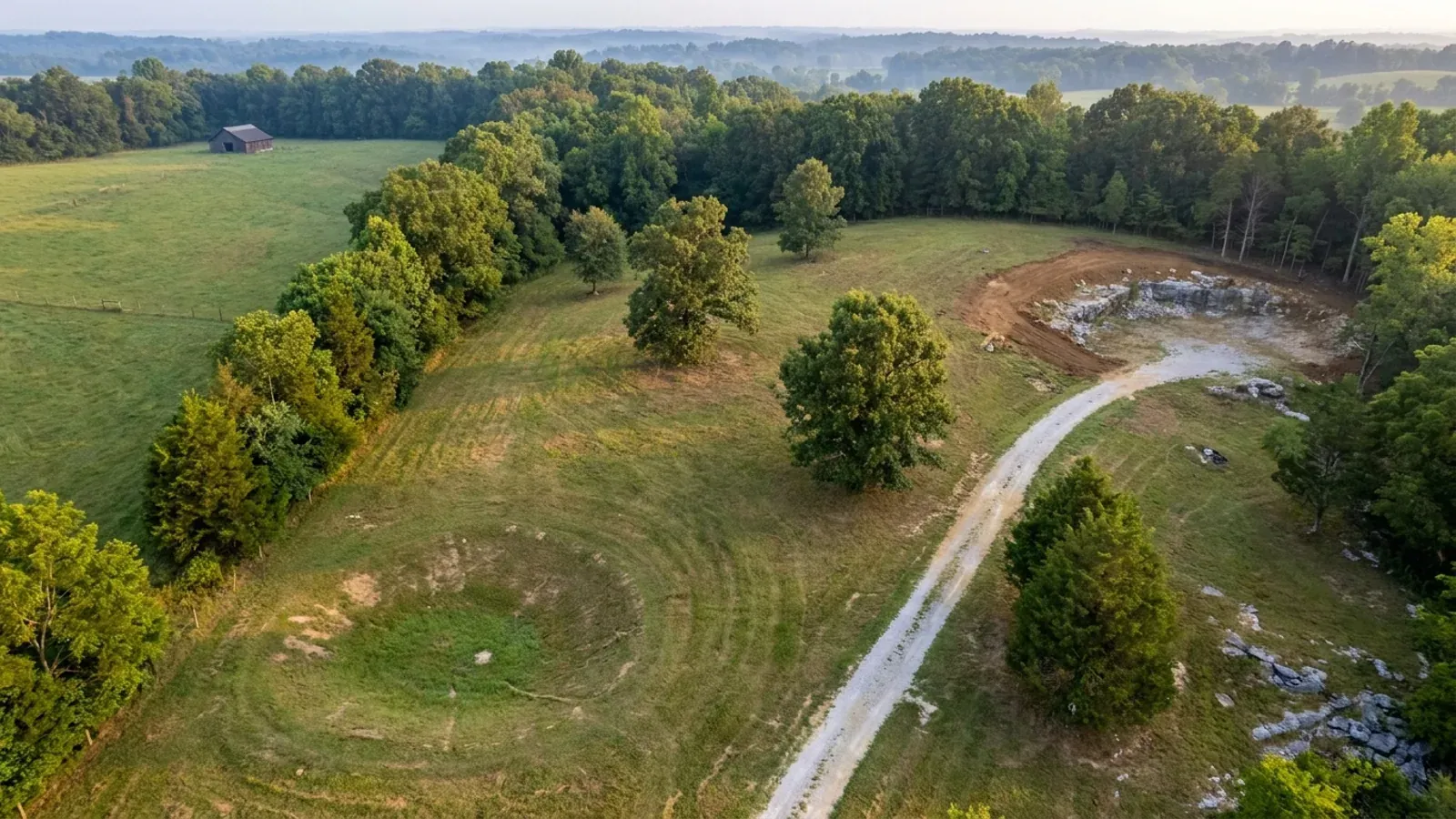
The parcel
Karst and mine maps, the flood question, zoning where the county has any, and utility access — all checked before anything is drawn.
Pad and permit
Clearing, grading and a compacted pad, while the submittal works through whichever office issues the permit — and where no office does, through the approvals that still apply.
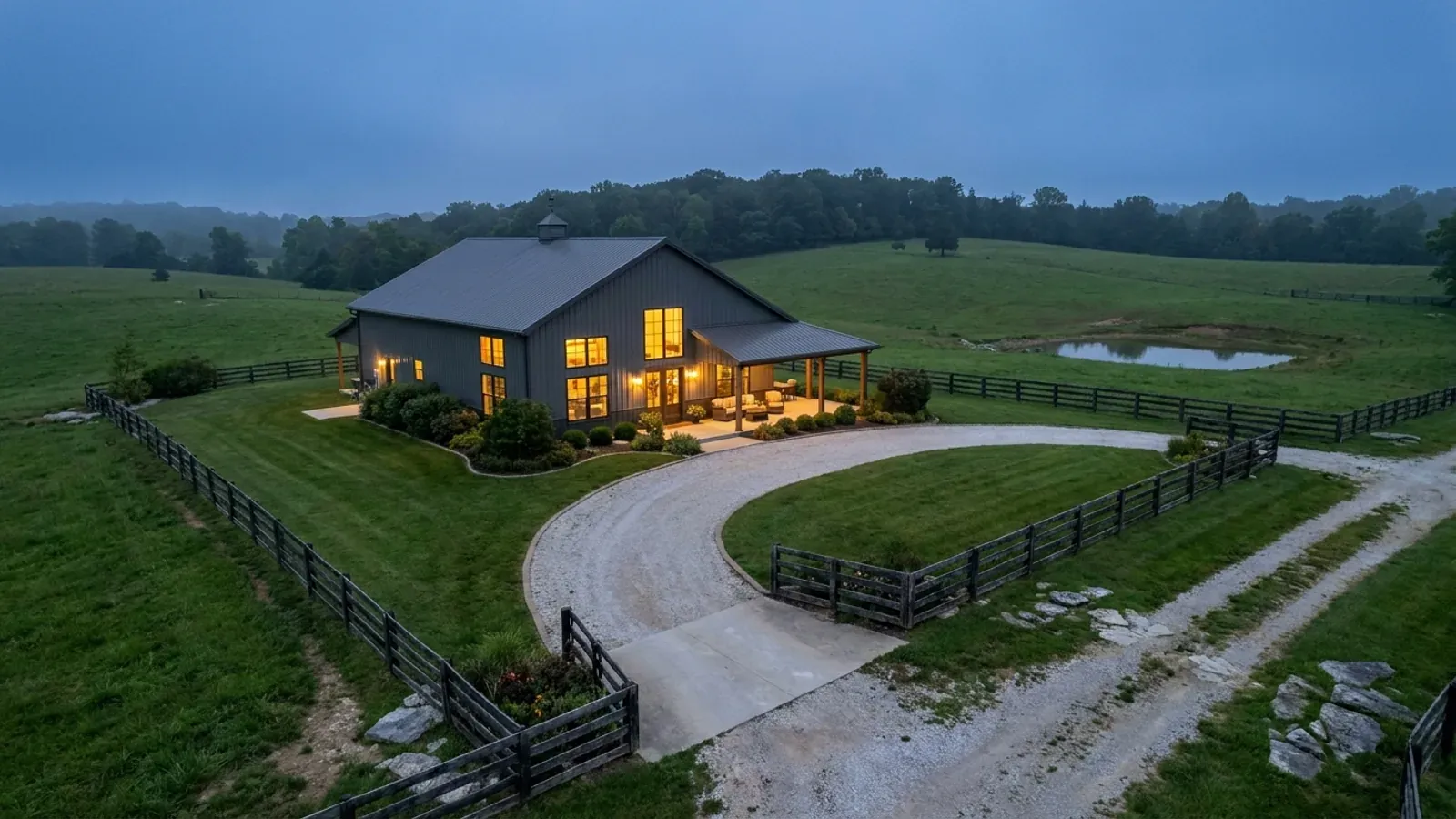
Frame to finish
Shell erected and dried in, then systems and interior finish — and the certified electrical inspection your utility needs before it will set a meter.
Those are the rules where you are building in Warren County. Tell us what you want to build and we will draw it to them.
Where we build around Warren County
Warren and the rural land around it. The buildable acreage for a project this size usually sits outside the city limits, and in Kentucky that line frequently decides whether anyone issues a permit at all, not merely who issues it.
Keep reading
The questions that usually come next once you know what Warren County allows.
Barndominium Cost Guide
Why the published spread runs from one end of the scale to the other, and which of it is the building rather than the ground.
Read itIs It Legal in Kentucky?
Whether your county inspects a house at all, what the farm-dwelling exemption really requires, and the approvals that reach you anyway.
Read itWhat a Pole Barn Home Costs
Post-frame against stick-built, and what the prescriptive post-frame section of the state code does and does not cover.
Read itNearby areas we build in
Others we cover nearby. They share the same statewide code and the same state-published design tables — but whether a house is permitted and inspected at all, whether the county zones, what the health department will accept for septic, and what the ground does to a foundation can all differ from one card to the next. Two counties that touch are not two versions of the same answer.
Building in Warren County: common questions
8 questions we get asked most often about building in Warren County. If yours is not on the list, ask it directly.
Do I need a building permit for a barndominium in Warren County?
How worried should I actually be about sinkholes here?
Can I build a shop bigger than the house?
Who issues the septic permit, and can a sinkhole cost me the parcel?
What design figures does a Warren County build have to meet?
Does my builder need a licence in Warren County?
Is there still land to buy in Warren County?
What happens if I just route the gutters into the sinkhole at the back of the property?
Building in Warren County?
Start with the plan. Tell us what you want to build and we will draw it, then confirm whether any office permits and inspects a house where your parcel is, what it will let you put there, and which line of the state's snow, frost and seismic tables your county falls on. That conversation costs nothing.