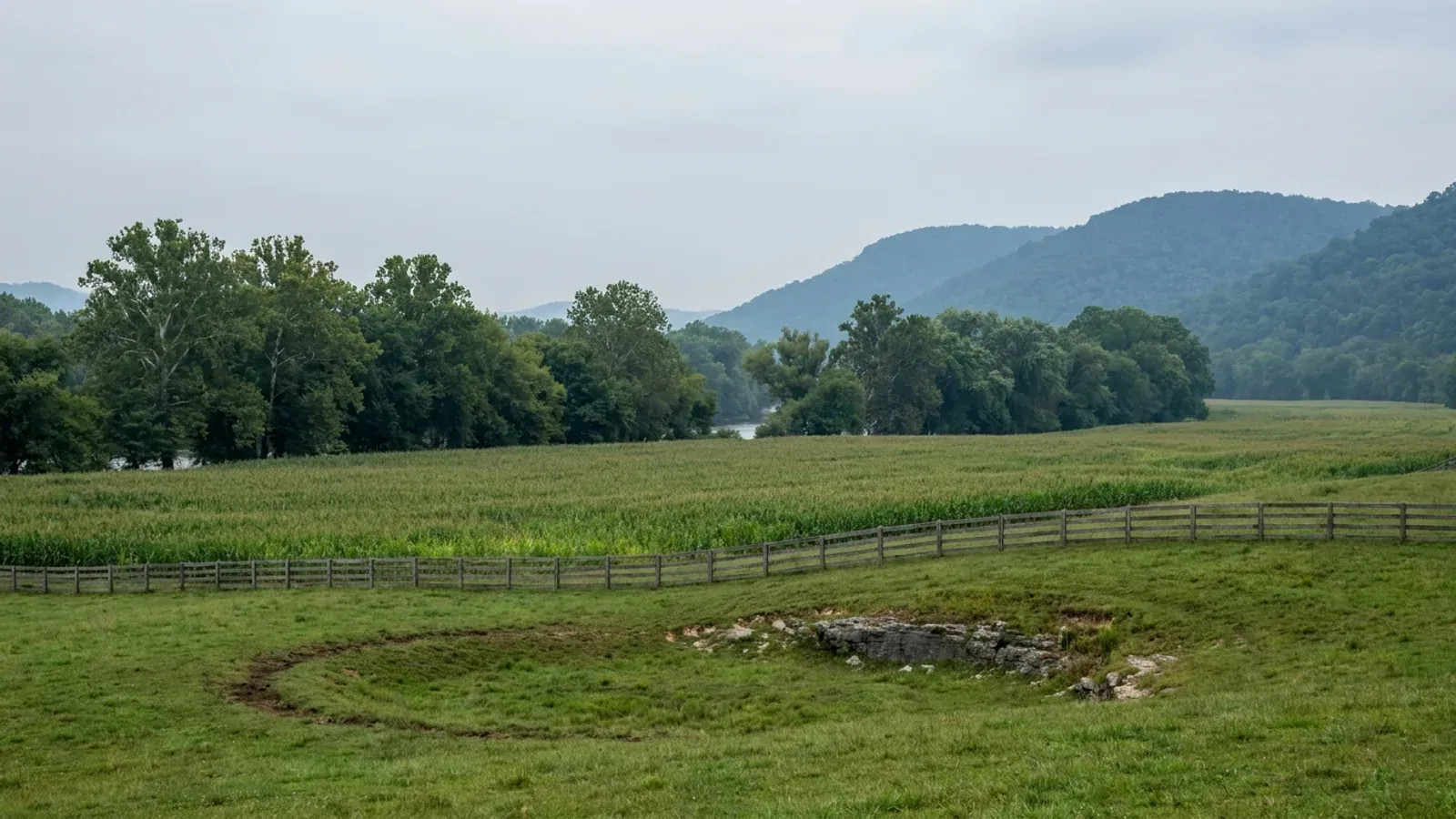
Barndominium Builders in Nelson County, KY
Nelson County is one of the Kentucky counties that decided, in writing, to inspect houses. Most did not. On 2 January 2024 the Nelson County Fiscal Court adopted Ordinance No. 2023-009, and its Section 4 extends the Kentucky Residential Code to require permits, inspections and certificates of occupancy for every detached one- and two-family dwelling in the county and for their accessory structures, expressly under the authority KRS 198B.060(1) gives a local government to do so. That is the ordinance the statute turns on, and it is published. On top of it sits a second, older layer: the Joint City-County Planning Commission of Nelson County writes one set of zoning regulations for Bardstown, Bloomfield, Fairfield, New Haven and the unincorporated county at once, re-adopted by the Fiscal Court as Ordinance No. 2025-004 on 18 June 2025. So a Nelson County build is a two-permit build in a fixed order — zoning compliance permit from the Planning Commission first, building permit from County Code Enforcement second — and the zoning permit dies if the building permit is not pulled within sixty days. Bardstown does not run its own building department; the county issues the permit inside the city limits as well as outside, which makes the answer here simpler than in Hardin County next door and stricter than in most of Kentucky. The rules that matter most to this building type are the accessory-structure rules. A shop is capped by the house: it may not exceed the height of the principal structure and must be subordinate in scale to it. An agricultural structure, by contrast, has no height limit at all under the same section. That single distinction is where the design conversation starts here. The ground is Knobs country. KGS puts Nelson across the Outer Bluegrass and the Knobs east of Muldraugh Hill, with elevations from about 390 feet where the Rolling Fork leaves the county to 1,090 feet at Rohan Knob — seven hundred feet of relief inside one county, conical hills standing 300 to 400 feet above the lowland, thick Devonian and Mississippian shales that KGS says are prone to sliding and slumping, sinkholes common on the flat uplands around Bardstown, and broad floodplains along the Rolling Fork and between the knobs in the west. And the bourbon economy is written into the zoning text: distilled spirits storage facilities are their own planned-unit use in the Agriculture district, with a 100-acre minimum and a 400-foot separation from houses that already exist when the application is filed.
Nelson County at a glance
- County
- Nelson
- Population
- 49,463
- ZIP codes
- 40004, 40008, 40012, 40013, 40020, 40051, 40052, 40107
- Site visits
- Same day
Building conditions in Nelson County
The building code is the same in every Kentucky county, and no local government may adopt or enforce a different one on a house — the Kentucky Residential Code says so in its own text. The design criteria are settled by the state too: the code prints a filled-in table covering all 120 counties, so your county's ground snow load, frost depth and seismic design category are published figures rather than something a local office decides. Ultimate design wind speed is 115 mph for every county in the state.
What changes from one county to the next is whether anyone checks. Kentucky makes permits, inspections and certificates of occupancy optional for a single-family home unless the local government has passed an ordinance requiring them, and it forbids the state from stepping in where none has. Twenty-five counties tell the state outright that they have no local building inspector, and in much of the rest the answer depends on an ordinance the county either passed or never did. Zoning is a separate, equally local choice — most Kentucky counties have never adopted any. What is below covers this county specifically: who issues the permit if anyone does, what the state's tables assign it, and what the ground does to a slab.
Nelson County Fiscal Court Ordinance No. 2023-009, An Ordinance relating to the Code Enforcement Department and the enforcement of the Kentucky Building Code, Sections 2, 3, 4, 6, 7 and 10 — https://nelsoncountyky.gov/wp-content/uploads/2024/04/CodeEnforcementOrdinanceCombined-asPassed12-27-23.pdf (PDF text extracted and read 6 Sep 2026) · https://nelsoncountyky.gov/ordinances/ · https://nelsoncountyky.gov/code-enforcement/ · https://apps.legislature.ky.gov/law/statutes/statute.aspx?id=52659 · corroborated by https://dhbc.ky.gov/Documents/Nelson%20County.pdf (sheet updated 3 Mar 2026), which is a contact directory rather than an ordinance register
Zoning Regulations for Bardstown, Bloomfield, Fairfield, New Haven and Nelson County, §9.4 Location and Height of Agricultural, Accessory, and Temporary Structures, as passed by Nelson County Fiscal Court 18 June 2025 (Ordinance No. 2025-004) — https://nelsoncountyky.gov/wp-content/uploads/2025/06/Zoning-Regulationsas-Passed-by-NCFC6-3-25.pdf (PDF text extracted and read 6 Sep 2026) · the Planning Commission's own copy, amended 1 March 2022, is at https://ncpz.com/PDF/Zoning-Regulations-amended-3-1-2022.pdf — the county's 2025 file is the later of the two and is the one used here · https://ncpz.com/planning
Zoning Regulations §6.1 Agriculture District — principal, accessory and conditional uses, §6.1E(1) Dimensional & Area, §6.1E(2) Minimum Lot Area Exception, §6.1H Division of Family Property — https://nelsoncountyky.gov/wp-content/uploads/2025/06/Zoning-Regulationsas-Passed-by-NCFC6-3-25.pdf (PDF text extracted and read 6 Sep 2026) · https://ncpz.com/zoning
Zoning Regulations §6.1D(4) Distilled Spirits Storage Facilities (Planned Unit Development uses permitted in the Agriculture District, in effect in Bardstown, New Haven and unincorporated Nelson County), conditions (a) through (j); and §6.1A, the parallel principal-use provision in effect in Bloomfield and Fairfield — https://nelsoncountyky.gov/wp-content/uploads/2025/06/Zoning-Regulationsas-Passed-by-NCFC6-3-25.pdf (PDF text extracted and read 6 Sep 2026) · https://ncpz.com/zoning
https://www.uky.edu/KGS/water/library/gwatlas/Nelson/Topography.htm (KGS Groundwater Resources of Nelson County — physiographic regions, elevations, Rohan Knob, Cecil Ridge, Indian Grave Ridge, Bardstown at 647 ft; read 6 Sep 2026) · https://kgs.uky.edu/kgsweb/download/misc/landuse/NELSON/nelsonissues.htm (KGS Nelson County land-use geologic issues — sinkholes, slope stability, foundations, flooding, Laurel Dolomite and Borden Formation; read 6 Sep 2026) · https://www.uky.edu/KGS/water/library/gwatlas/Nelson/Karst.htm · https://www.uky.edu/KGS/geoky/regionknobs.htm · https://www.uky.edu/KGS/water/library/gwatlas/wprkarst.html (the five named karst regions and the cities KGS assigns to each) · https://kgs.uky.edu/kygeode/geomap?gkarst=true (Karst Potential Index viewer)
https://dhbc.ky.gov/Documents/2018%20Kentucky%20Residential%20Code%203d%20Ed.pdf — Table R301.2(1) Design Snow, Climatic and Geometric Design Criteria for Kentucky Counties (snow, wind, weathering, termite rows), Table R301.2.2.1 Seismic Design Categories–Site Class D, Table R403.1.4 Minimum Frost Protection Depth for Kentucky with §R403.1.4, Table R401.4.1 Presumptive Load-Bearing Values, and §R301.2.2 Exception 1; the county rows are transcribed in research/statewide/design-criteria-and-climate.md and were not re-fetched · the Nelson County Code Enforcement Department publishes Kentucky Residential Code editions from its own page: https://nelsoncountyky.gov/code-enforcement/
Also worth knowing before you build in Nelson County
- Two permits in a fixed order, and the zoning permit dies in sixty days if the building permit is late
- Nelson County runs the zoning approval and the building approval as separate permits from separate offices, and the ordinance sequences them. §3.2 of the zoning regulations requires a zoning compliance permit before any land is used or any structure erected, moved, added to, structurally altered, demolished or changed in use, and before any grading takes place — issued by the Planning Commission Director within one week of a complete submission under §3.4. §3.3 lists what has to travel with the application: the completed Building and Zoning Compliance Permit form, a copy of the deed or plat, a plot plan drawn to scale showing lot dimensions, all existing and proposed structures, and setbacks measured from the overhang to the property line, an approved entrance or encroachment permit, an approved stormwater management plan where applicable, and an approved on-site septic evaluation or final inspection from the health department. §3.7 then sets the clock: if a building permit has not been obtained within sixty consecutive calendar days of the zoning compliance permit being issued, the zoning permit expires and is cancelled, and no building permit may be obtained until a new zoning permit is issued. A second clock follows — if substantial completion is not reached within twelve months the zoning permit expires, in unincorporated Nelson County and in Bardstown and Bloomfield; in Fairfield and New Haven the window is six months. Renewal before the expiry date waives the fee. §3.8 places the certificate of occupancy inside the building permit and issues it through the Nelson County Building Inspector, and makes it unlawful for an owner to use a new or enlarged building until it issues. The county's own new-home checklist confirms the same order on one page and adds the practical items: floor plans at 8.5 by 11, a signed address request form, the approved encroachment permit, three building inspections (footer, framing, final) and three electrical inspections (rough-in, temporary on the main, final).
- A 1,000 square foot line in the fee ordinance decides whether the shop gets inspected
- Nelson County publishes its permit and inspection fees inside the code enforcement ordinance itself rather than only on a separate sheet, which means they are readable and dated. Under Section 5.1, all fees are payable to the Nelson County Fiscal Court and the minimum inspection fee is $75. A one- or two-family dwelling, patio home, townhome or multi-family structure — new construction and additions — is $225, covering a minimum of three inspections with written reports (footer, framing, final). An accessory structure in excess of 1,000 square feet, the ordinance naming garages and storage buildings, is $150 and carries two inspections with written reports (footer and final). And the note beneath it is the one to read twice: accessory structures below 1,000 square feet are exempt from fee and inspection. An additional or failed site inspection is $75. The electrical schedule in the same ordinance charges $147 for a single-family house of 3,000 square feet or smaller and $175 above 3,000 square feet, three inspections either way; an unfinished garage or storage building is $49 for one inspection and a finished one $98 for two; a new service installation, a generator or a solar array is $49; and a homeowner seeking an electrical permit must own the property and physically live on site. The mechanical schedule charges $105 for a typical single-family residence with one system appliance and $155 with two, with the ordinance's own note that the code enforcement officer may visit a site numerous times to advise and review ongoing work at no additional cost. Section 5.4 escalates every fee each 1 July by the change in the US Department of Labor Consumer Price Index, so the published numbers are a floor that moves. The separate scanned fee sheet linked from the Code Enforcement page has no text layer and cannot be read by machine; the ordinance above is the readable source and the department is the place to confirm the current escalated figures.
- Nelson runs its own electrical and HVAC inspectors, which most Kentucky counties do not
- In most of Kentucky the electrical, plumbing and HVAC inspections on a new house are state functions assigned to a Department of Housing, Buildings and Construction inspector who covers several counties. Nelson County took two of the three in-house. The DHBC county sheet for Nelson, updated 3 March 2026, lists Nelson County Code Enforcement at One Court Square Suite 202 on 502-348-1862 as both the Local Building Inspector and the HVAC Inspector, naming Logan Spaulding — and the county's own code enforcement ordinance carries full electrical and mechanical permit and inspection fee schedules of its own, with electrical inspections scheduled on 502-348-1862 or 1895 between 8 a.m. and 4 p.m. The Planning Commission's construction guide sends the licensed electrical contractor and the licensed mechanical contractor to the same county office. Plumbing is the exception and stays outside that office: the guide sends the licensed plumbing contractor to the plumbing inspector at the Nelson County Health Department on South Third Street, and DHBC assigns Nelson a state plumbing inspector. The state layer does not disappear either way: DHBC lists a state building inspector, a state electrical inspector, a state manufactured housing inspector, an elevator inspector and a boiler inspector against Nelson, and under KRS 198B.060(11) no utility may initiate permanent electrical service to a new building until a certified electrical inspector issues a final certificate of approval. The practical effect for a build here is that the electrical and mechanical scheduling calls go to Bardstown rather than to a regional state inspector, which usually shortens them.
- The floodplain ordinance is a year old, the County Engineer administers it, and the lowest floor sits at base flood elevation
- Nelson County recompiled Article 16 of its zoning regulations into a standalone document and then amended it: the Nelson County Floodplain Management Ordinance, No. 2024-009.1, had its first reading on 26 August 2025 and was adopted on 2 September 2025. Section 3 appoints the Nelson County Engineer as Floodplain Administrator. Section 4 requires a development permit before any construction or other development begins in a special flood hazard area, and states plainly that endorsement of the local administrator is required before a state floodplain construction permit can be processed — the two-permit reality Kentucky builders elsewhere learn late. The specific standard for a house is that new construction or substantial improvement of any residential structure or manufactured home shall have the lowest floor, including basement, mechanical equipment and ductwork, elevated no lower than at or above the base flood elevation, with two feet above highest adjacent grade in an AO zone where no depth number is printed on the FIRM. That is a bare base-flood-elevation standard with no county freeboard added, which is worth noting because Hardin County next door requires one foot above BFE — the same house on the same contour is held to a different floor level a county apart. A certified elevation survey of the lowest floor must go to the administrator and to the state once the floor is placed and before construction continues. On top of it all sits the state permit: KRS 151.250 and 401 KAR 4:060 §2 require a Kentucky Division of Water Individual floodplain construction permit, applied for on form DOW 7116, and state jurisdiction reaches the whole base floodplain rather than only the regulatory floodway. FEMA's Community Status Book lists five Nelson County communities, all in the National Flood Insurance Program's regular phase: unincorporated Nelson County (CID 210177C, initial FIRM 5 November 1980), Bardstown (210178C, 19 November 1980), Bloomfield (210179C, 4 June 1980), Fairfield (210424C, 24 May 2011) and New Haven (210180C, 5 November 1980). Four of the five carry a current effective map date of 16 October 2025 — the same countywide remap that took effect in Hardin — while New Haven's map dates from 23 May 2023. No CRS class is shown for the county or for Bardstown; a 16 January 2020 date appears against Fairfield in the column the Status Book uses for CRS entry, and the Kentucky Division of Water floodplain office is the place to confirm what class, if any, that community holds.
- Inside Bardstown a land disturbance permit starts at 1,000 square feet and carries a refundable bond
- The City of Bardstown does not issue building permits — its own site sends builders to Nelson County Code Enforcement and the Nelson County Planning Commission for the building and zoning compliance permit. What Bardstown does run, and what surprises people, is a stormwater land disturbance programme with a much lower trigger than the one-acre federal threshold most builders expect. A land disturbance permit is required for any activity disturbing more than 1,000 square feet, which a house pad, a driveway and a septic field clear easily. The published classes put minor work and additions in Class 1 at a $50 permit fee with a $750 minimum performance bond, and single-family and multi-family homes in Class 2 at a $300 permit fee with a $1,000 minimum bond; the bond is refunded in full on final inspection by the City Stormwater Inspector. The permit runs twelve months and an extension must be requested no later than fourteen days before it expires, and contractors must hold a valid Bardstown business licence. The city inspects twice — before concrete or asphalt is placed, and again once the site reaches 70 percent vegetative cover. Outside the city the equivalent is narrower: the Planning Commission's construction guide sends commercial, industrial and multi-family projects to the Nelson County Engineer at the Road Department for drainage plan approval, and the county adopted a separate Drainage Ordinance, No. 2023-010. A copy of whichever approval applies has to be attached to the zoning compliance permit application.
- Septic comes from Lincoln Trail's Bardstown office, and the evaluation has to be in hand before the zoning permit
- Nelson County's on-site sewage permits are issued by the Lincoln Trail District Health Department, a six-county district covering Hardin, LaRue, Marion, Meade, Nelson and Washington from an administrative office at 108 New Glendale Road in Elizabethtown. The office a Nelson County build actually deals with is the district's Nelson County health centre at 325 South Third Street, Bardstown — the address DHBC's county sheet and the Planning Commission's construction guide both print — with environmental services on 502-348-3698 and the main line on 502-348-3222. It is locally signed as the Nelson County Health Department, which is why it is easy to mistake for a standalone county agency; it is the district's Nelson office. The district's published sequence starts before any drawing: submit a site evaluation application giving the property address, the surveyed site boundaries, the locations of existing structures and wells, the proposed system location and, for a residence, the bedroom count and whether there will be a garbage disposal or a basement; pay the $300 site evaluation fee; the inspector marks a usable area which must then remain undisturbed; and only where the site rates suitable or provisionally suitable may a certified installer apply for the permit. An inspection of an existing system is $100, and card payments carry a 5 percent surcharge. What is specific to Nelson County is where that paperwork lands: §3.3(F) of the zoning regulations makes an approved on-site septic system evaluation or final inspection from the health department a required attachment to the zoning compliance permit application, so the septic answer gates the zoning permit, which in turn gates the building permit. Under 902 KAR 10:085 the site must also carry a full replacement area alongside the system, and an area closer than seventy feet to an open sinkhole throat or downslope from the sinkhole sideslope midpoint is unsuitable — which is not an abstract rule on the sinkhole-pocketed uplands around Bardstown.
- Land in farms fell 26 percent in five years — the steepest drop of any county in this axis
- USDA's 2022 Census of Agriculture county profile for Nelson County counts 1,241 farms across 157,488 acres, averaging 127 acres. The changes since 2017 are the story: farm count down 13 percent, average farm size down 15 percent, and land in farms down 26 percent. That is a quarter of the county's farmland leaving the agricultural census in five years, and it is a far steeper fall than Hardin County next door recorded over the same period at 5 percent. The size distribution still favours a homesite buyer: 564 farms of 10 to 49 acres, 45 percent of all farms and the modal band, plus 365 in the 50-to-179-acre band, 128 under 10 acres, 119 at 180 to 499, 42 at 500 to 999 and 23 at 1,000 acres or more. Land in farms breaks down as 89,973 acres of cropland, 30,610 of woodland, 27,621 of pastureland and 9,284 other, and crops account for 72 percent of the county's $79.5 million in agricultural sales, with grains and oilseeds at $50.2 million the dominant line. What that means qualitatively is competition for the same ground. Nelson is a grain county in a distillery market, and rural acreage here is bid for by three different buyers at once: row-crop operators, the bourbon industry's 100-acre warehouse sites and their 25-percent conservation dedications, and residential buyers priced out of the Louisville metro to the north. The county grew 5.8 percent between the 2020 Census and current estimates, to roughly 49,500 people across 423 square miles — about 111 per square mile, denser than the classic Kentucky land counties but well under Bullitt's 275. A search here is real but competitive; if it stalls, the neighbours in this axis with more room are Shelby and, on the Elizabethtown side, Hardin.
- Radon Zone 1, no mine subsidence fund, and the code that does not require a radon system
- Two hazard questions with counter-intuitive answers, and they run opposite ways here. On radon, EPA's Map of Radon Zones puts thirty Kentucky counties in Zone 1, its highest predicted indoor screening class, and Nelson is one of them — as are its neighbours Bullitt, Marion and Boyle, while Hardin County next door is not. Kentucky's Zone 1 map is essentially its karst-and-limestone map, and Nelson's limestone uplands are why it lands there. Two caveats travel with that: EPA's map dates from 1993 and EPA itself prints that it should not be used to decide whether an individual home needs testing and that all homes should be tested regardless of zone. And the code offers no help — the Kentucky Residential Code adopts appendices K, R and S and does not adopt Appendix F, Radon Control Methods, so radon-resistant construction is required nowhere in Kentucky. A passive sub-slab depressurisation rough-in is inexpensive while the slab is open and expensive afterwards, which on a Zone 1 county is the whole argument. On mine subsidence the answer is the other way: Kentucky's Mine Subsidence Insurance Fund covers 37 counties whose fiscal courts voted the coverage in, and in those counties KRS 304.44-030 adds the endorsement to every property policy automatically unless the insured waives it in writing. Nelson is not one of the 37 — the fund maps the two coal fields and neither reaches here — so there is no automatic endorsement on a Nelson County policy and no need to waive one. Nelson does appear in the tail of KGS Information Circular 31's ranking of counties with ten or more inventoried landslides, which is consistent with the slumping shales KGS describes in the Knobs, and per-county landslide counts are not readable from that figure and should not be quoted.
- Slopes over 25 percent and prime farmland soils are named conservation resources in the subdivision rules
- Nelson County's zoning regulations carry a full conservation-design chapter, and it is one of the few places in the Kentucky axis where slope and soil class appear as regulated terms rather than as advice. §8.42(E) states that lands within the 100-year floodplain, lands having slopes in excess of 25 percent, and rock outcroppings constitute environmentally sensitive areas where disturbance shall be strictly minimised, and makes a demonstration that those features will be protected a prerequisite to approval of both the conceptual preliminary plan and the detailed final plan. §8.46(I) then ranks the resources a subdivision's greenway land must incorporate, in order of significance, and the list runs: stream channels, floodplains, wet soils, swales and springs; significant natural areas of listed species; moderate to steep slopes, particularly those adjoining water courses and ponds; healthy woodlands; groundwater recharge areas; hedgerows and significant trees; Class I, II and III agricultural soils as defined by the USDA Natural Resource Conservation Service; historic structures and sites; and visually prominent topographic features such as knolls, hilltops and ridges, and scenic viewsheds as seen from public roads. §8.46(H), Rural Road Corridors and Scenic View-sheds, requires every subdivision and land development application to attempt to preserve the scenic visual corridors along such roads, with naturalistic landscape buffers required where design alone does not do it — and the species for those buffers must be chosen from an inventory of what already grows in nearby hedgerows and wooded roadside edges. In A-1 the cluster-residential planned unit development that yields one-acre lots carries the same instruction in three words: view-shed must be preserved, plus a recorded deed restriction barring further division of the remnant parcel. None of this reaches a single house on an existing lot. All of it reaches anyone dividing land, and it is the reason ridge-line and roadside acreage in Nelson County comes with more conditions than the same ground would in an unzoned county.
- An agricultural structure still needs a zoning permit here — but the fee is waived
- The most common misreading of Kentucky's rules is that a farm building needs nothing. In Nelson County that is not quite right, and the ordinance is unusually clear about the shape of the exemption. §3.2(B)(1) of the zoning regulations states that a zoning compliance permit is required to erect, move, add to, demolish or structurally alter an agricultural structure — to ensure compliance with use, minimum setback and floodplain requirements — and that a plot plan and an affidavit verifying the agricultural use, attested by the owner's signature, must accompany the application. What the ordinance then waives is the money: zoning compliance permit fees shall be waived for qualified agricultural structures. So the paperwork exists, the setback and floodplain review happens, and the fee does not. The building-permit side runs on a parallel exemption. The Planning Commission's construction guide states that building permits are required for all new construction, alterations and additions with the exception of agricultural structures, accessory structures less than 120 square feet, above-ground pools and decks — though that guide is dated 2012 and the county's 2024 code enforcement ordinance sets the accessory-structure inspection line at 1,000 square feet rather than 120, so the ordinance is the number to work from and the department is the place to reconcile the two. Alongside all of this sits the statutory route the Kentucky Building Code itself provides: a dwelling on a working farm can fall outside the building code only where the farm is a PVA-registered farm of ten contiguous acres or more outside city limits, and even then zoning still reaches the dwelling under KRS 100.203(4)(c). That condition travels with the exemption every time it is mentioned. In a county that has expressly extended the Residential Code to dwellings and their accessory structures by ordinance, the honest answer is that the farm route is narrow and is a conversation with the Planning Commission and the PVA, not an assumption to build on.
Zoning Regulations §3.2 through §3.8 — https://nelsoncountyky.gov/wp-content/uploads/2025/06/Zoning-Regulationsas-Passed-by-NCFC6-3-25.pdf (PDF text extracted and read 6 Sep 2026) · Nelson County Home Building Guide: Your Checklist — https://nelsoncountyky.gov/wp-content/uploads/2024/11/SFH-in-Nelson-County.pdf (read 6 Sep 2026) · Building & Zoning Compliance Permit Application — https://nelsoncountyky.gov/wp-content/uploads/2023/05/Building-Zoning-Compliance-Permit-Application-revised-5-3-12.pdf · Building & Construction Reference Guide, Joint City-County Planning Commission, rev. 08/16/2012 — https://ncpz.com/PDF/BuildingConstructionReferenceGuide2.pdf
Nelson County Fiscal Court Ordinance No. 2023-009, Section 5 Permits and Fees, Section 5.1 Fees (building, electrical and mechanical schedules), Section 5.3 and Section 5.4 Consumer Price Index — https://nelsoncountyky.gov/wp-content/uploads/2024/04/CodeEnforcementOrdinanceCombined-asPassed12-27-23.pdf (PDF text extracted and read 6 Sep 2026) · the county's separate Building Permit and Inspection Fee Schedule at https://nelsoncountyky.gov/wp-content/uploads/2023/08/buildingPermitInspectionFee.pdf and the electrical pricing sheet at https://nelsoncountyky.gov/wp-content/uploads/2025/09/PRICING.pdf are both image-only scans with no extractable text layer, so the ordinance text was used instead · https://nelsoncountyky.gov/code-enforcement/
https://dhbc.ky.gov/Documents/Nelson%20County.pdf (DHBC Nelson County sheet, updated 3 Mar 2026; PDF text extracted and read 6 Sep 2026 — a contact directory, not an ordinance register) · Nelson County Fiscal Court Ordinance No. 2023-009, Electrical Permit/Inspection Fee Schedule and Mechanical Permit/Inspection Fee Schedule, Sections 5.2 and 5.3 — https://nelsoncountyky.gov/wp-content/uploads/2024/04/CodeEnforcementOrdinanceCombined-asPassed12-27-23.pdf · https://ncpz.com/PDF/BuildingConstructionReferenceGuide2.pdf · https://apps.legislature.ky.gov/law/statutes/statute.aspx?id=52659
Nelson County Floodplain Management Ordinance No. 2024-009.1, Section 3 Designation of Local Administrator, Section 4 Establishment of Development Permit, and the Specific Standards for residential structures — https://nelsoncountyky.gov/wp-content/uploads/2025/09/FloodplainOrdinance.pdf (PDF text extracted and read 6 Sep 2026) · https://nelsoncountyky.gov/ordinances/ · https://ncpz.com/floodplain (the Planning Commission's copy of the older Article 16, amended 5-13-11, is an image-only scan with no text layer, so the county's 2025 ordinance was used) · https://www.fema.gov/cis/KY.html (Kentucky Community Status Book, Nelson County rows read 6 Sep 2026) · https://apps.legislature.ky.gov/law/statutes/statute.aspx?id=54097 · https://eec.ky.gov/Environmental-Protection/Water/FloodDrought/Pages/default.aspx
https://www.cityofbardstown.org/government/stormwater/residents_and_home_builders/index.php (City of Bardstown, Residents and Home Builders — permit authority statement, 1,000 sq ft threshold, Class 1 and Class 2 fees and bonds, 70 percent vegetation inspection; read 6 Sep 2026) · https://ncpz.com/PDF/BuildingConstructionReferenceGuide2.pdf (drainage plan approval routing) · Nelson County Drainage Ordinance 2023-010 — https://nelsoncountyky.gov/wp-content/uploads/2024/10/DrainageOrdinance10-1-24.pdf · https://nelsoncountyky.gov/ordinances/
https://ltdhd.org/on-site-sewage/ (Lincoln Trail District Health Department — counties served, six-step process, $300 site evaluation, $100 existing system inspection, 5 percent card fee; read 6 Sep 2026) · https://dhbc.ky.gov/Documents/Nelson%20County.pdf (Nelson County Health Department, 325 South Third Street, Bardstown) · https://ncpz.com/PDF/BuildingConstructionReferenceGuide2.pdf (Nelson County Health Department, Environmental Services, 325 South Third Street, 348-3698) · Zoning Regulations §3.3(F) — https://nelsoncountyky.gov/wp-content/uploads/2025/06/Zoning-Regulationsas-Passed-by-NCFC6-3-25.pdf · https://apps.legislature.ky.gov/law/kar/titles/902/010/085/
https://www.nass.usda.gov/Publications/AgCensus/2022/Online_Resources/County_Profiles/Kentucky/cp21179.pdf (2022 Census of Agriculture, Nelson County profile, FIPS 21179 — PDF text extracted and read 6 Sep 2026) · population, land area and density from research/statewide/geography-and-population.md (2020 Census plus current estimate)
https://www.epa.gov/sites/default/files/2014-08/documents/kentucky.pdf (EPA Map of Radon Zones for Kentucky and its printed caveats; the county-by-county Zone 1 roster is not machine-readable from the EPA graphic and is corroborated across two third-party renderings of the same map rather than a primary EPA table — see research/statewide/soils-karst-and-slopes.md) · https://kygs.uky.edu/geology/radon · https://insurance.ky.gov/PPC/Documents/JAN%202025_Revised%20Mine%20Subsidence%20Insurance%20Fund%20080124.pdf (37-county list, brochure revised 08/24 effective 1/1/25 — Nelson is absent) · https://insurance.ky.gov/ppc/Documents/bulletin0904minesubs092109.pdf · KGS Information Circular 31 Figure 11, as transcribed in research/statewide/soils-karst-and-slopes.md · https://minemaps.ky.gov/
Zoning Regulations §8.4 Conservation Subdivisions — §8.42(E) Sensitive Area Disturbance, §8.44(A) Dimensional Standards for Option 1, §8.46(H) Rural Road Corridors and Scenic View-sheds, §8.46(I) Greenway Design Review Standards, and §6.1D(1) Cluster Residential Development — https://nelsoncountyky.gov/wp-content/uploads/2025/06/Zoning-Regulationsas-Passed-by-NCFC6-3-25.pdf (PDF text extracted and read 6 Sep 2026) · https://ncpz.com/zoning · Subdivision Regulations for Nelson County — https://ncpz.com/PDF/Sub%20Regs%20(amended%202-26-08).pdf
Zoning Regulations §3.2(B)(1) Agricultural Structures and Article 5 definitions of Agricultural Structure and Agricultural Operation — https://nelsoncountyky.gov/wp-content/uploads/2025/06/Zoning-Regulationsas-Passed-by-NCFC6-3-25.pdf (PDF text extracted and read 6 Sep 2026) · https://ncpz.com/PDF/BuildingConstructionReferenceGuide2.pdf (JCCPC Building & Construction Reference Guide, rev. 08/16/2012, building permit exceptions) · Ordinance No. 2023-009 §5.1, the 1,000 sq ft accessory-structure line — https://nelsoncountyky.gov/wp-content/uploads/2024/04/CodeEnforcementOrdinanceCombined-asPassed12-27-23.pdf · https://apps.legislature.ky.gov/law/statutes/statute.aspx?id=26719 · Nelson County PVA — https://qpublic.net/ky/nelson/
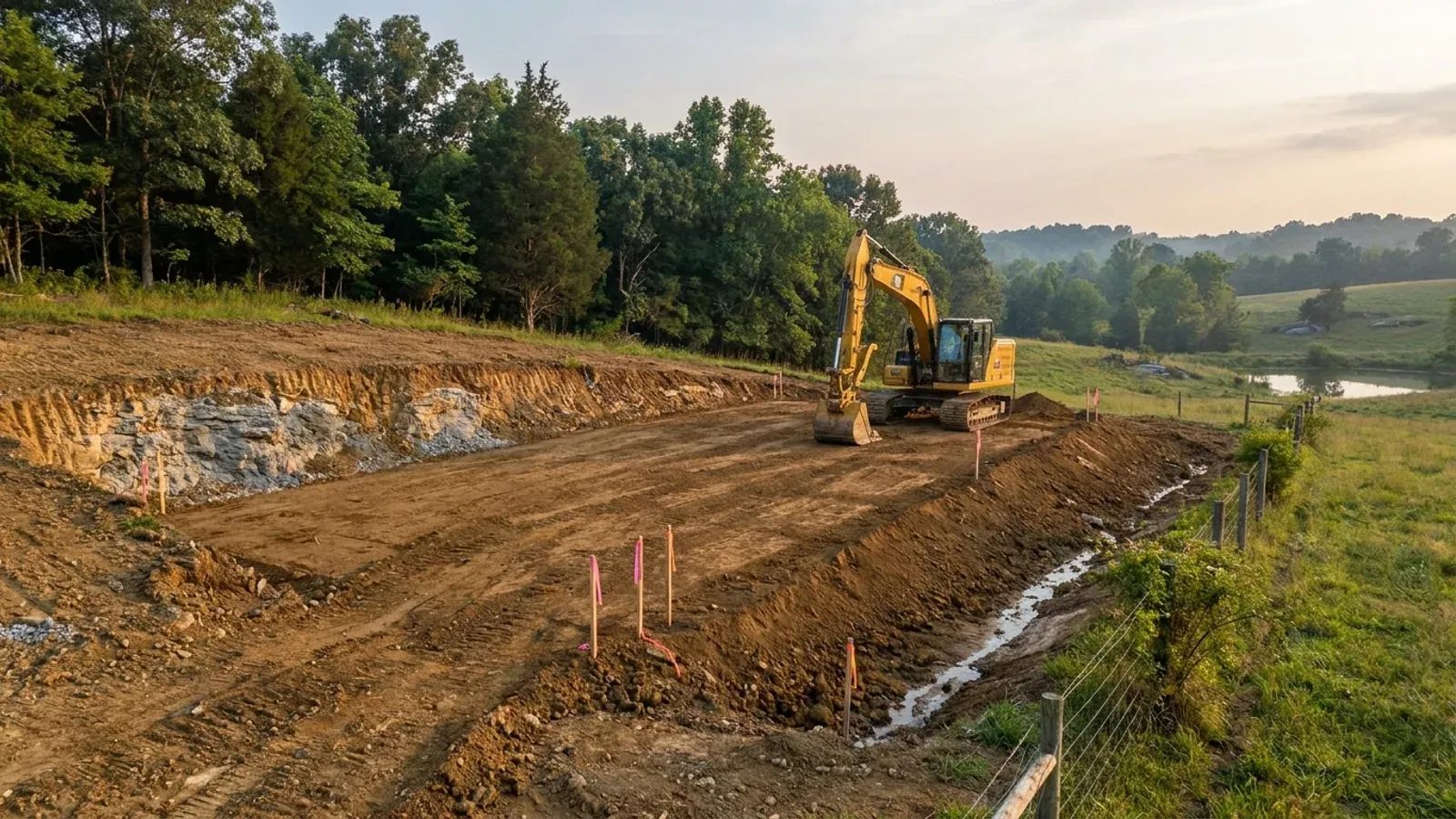
The expensive surprises are in the ground, not the building
What moves a Kentucky budget is usually below grade, and more often than not it is what the ground is sitting on rather than the ground itself. The Kentucky Geological Survey says 92 of the state's 120 counties contain karst — limestone that dissolves — across four named areas: the Western Pennyroyal around Bowling Green and Hopkinsville, the Inner Bluegrass around Lexington, the Eastern Pennyroyal through Somerset and Monticello, and Pine Mountain in the south-east. On karst, KGS's own model ordinance for local governments lists the structures that should not be sited in sinkhole areas, and the list is buildings with soil-bearing foundations and buildings that cover thousands of square feet with impermeable surface. A post-frame or steel building on a monolithic slab is both of those at once. KGS is equally clear that nearly all karst parcels still have buildable ground on them — so karst does not stop the build, it removes the option of siting the pad by eye. A filled and graded-over sinkhole is the classic trap, because the pad looks perfect.
In the two coal fields the question is undermining instead, and Kentucky treats it differently from everything else: mine subsidence coverage is added automatically to property policies in the counties whose fiscal court voted the fund in, with a written opt-out — thirty-seven of them — while karst collapse gets no fund at all and falls under the ordinary earth-movement exclusion. On slopes the surprise is geographic: KGS's landslide inventory puts Kenton, Campbell, Boone and Gallatin — the northern Kentucky counties opposite Cincinnati — near the very top, above most Appalachian counties, on Ordovician shale. Three of those four — Boone, Campbell and Kenton — are the only counties in the state with a line of their own in the residential code's bearing table, which raises the presumptive value for two named clay groups there and nowhere else. Everywhere else the table gives clay and silt a single presumptive figure, and a soils investigation becomes mandatory once the building official determines the real capacity is likely to be lower than it.
The same ground then sizes the septic system, and Kentucky does that from soil morphology — a certified inspector reading the profile in a backhoe pit — rather than from a percolation test, at 110 gallons a day per bedroom against an application rate taken from soil texture and structure. On a mound or other alternative design a measured permeability test can still be required. And on karst the septic regulation is blunter than the building code ever gets: it declares the ground within seventy feet of an open sinkhole throat unsuitable outright. The soil that needs a foundation engineer is usually the soil that complicates the drainfield, so the site work, the foundation and the septic get resolved together rather than one at a time. We price the dirt before we price the building.
What we build in Nelson County
All seven services are available in Nelson County. What a build costs depends far more on the parcel than on square footage, so we price against your land rather than publishing a rate card.
Barndominium Kits
We check barndominium kit packages against the wind, snow, frost and seismic criteria the Kentucky Residential Code publishes for your county.
Pole Barn Homes
Pole barn homes across Kentucky. KRC §R327 covers accessory barns, not houses — so a pole barn home is engineered by the code's own terms.
Custom Barndominium Plans
Barndominium plans drawn to Kentucky's published county design criteria — snow, wind, seismic, frost — with engineering where the code calls for it.
What a build looks like
Three stages every Nelson County project passes through, from a raw parcel to a finished home. Site work first, because that is where the budget is decided.
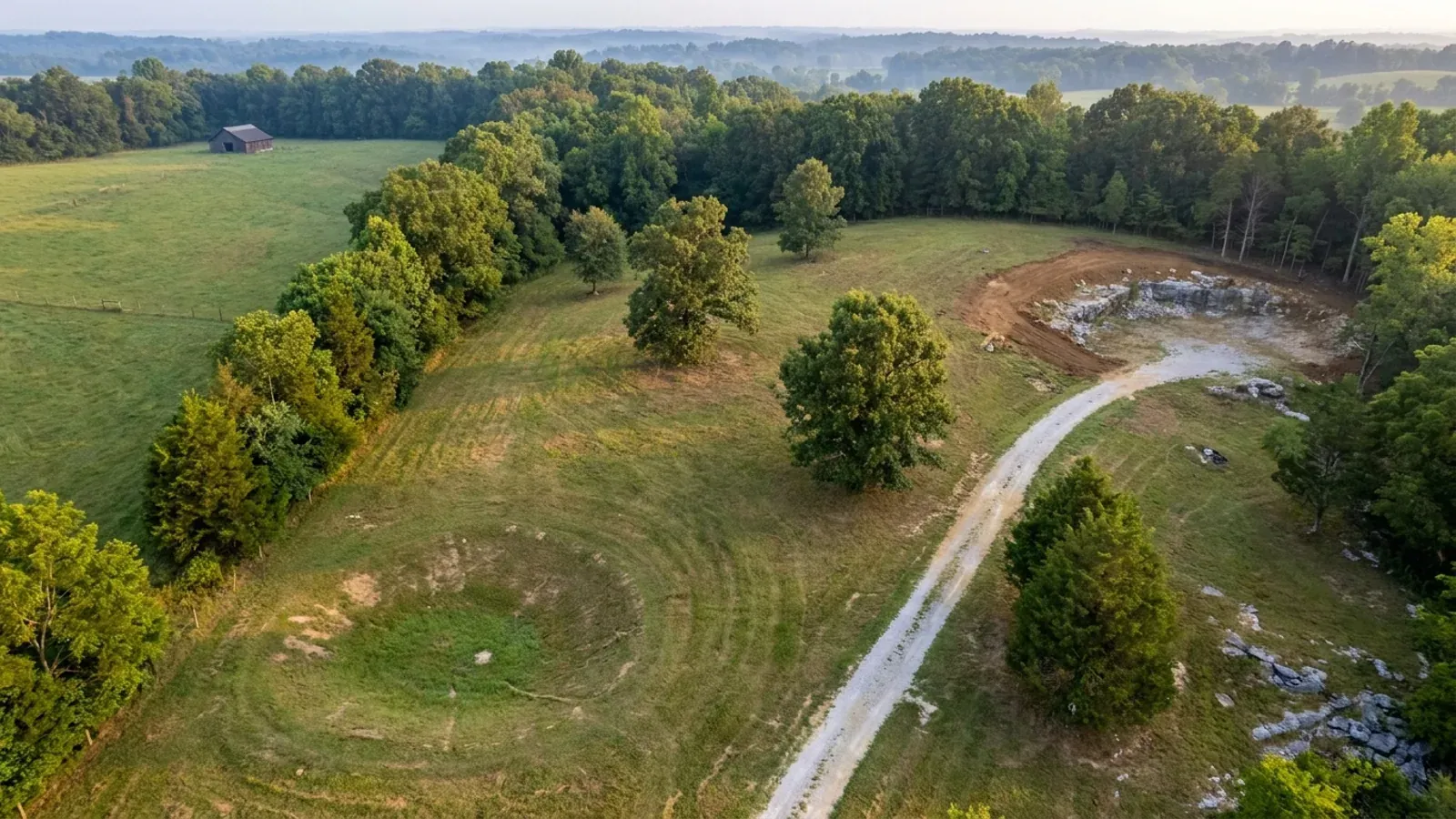
The parcel
Karst and mine maps, the flood question, zoning where the county has any, and utility access — all checked before anything is drawn.
Pad and permit
Clearing, grading and a compacted pad, while the submittal works through whichever office issues the permit — and where no office does, through the approvals that still apply.
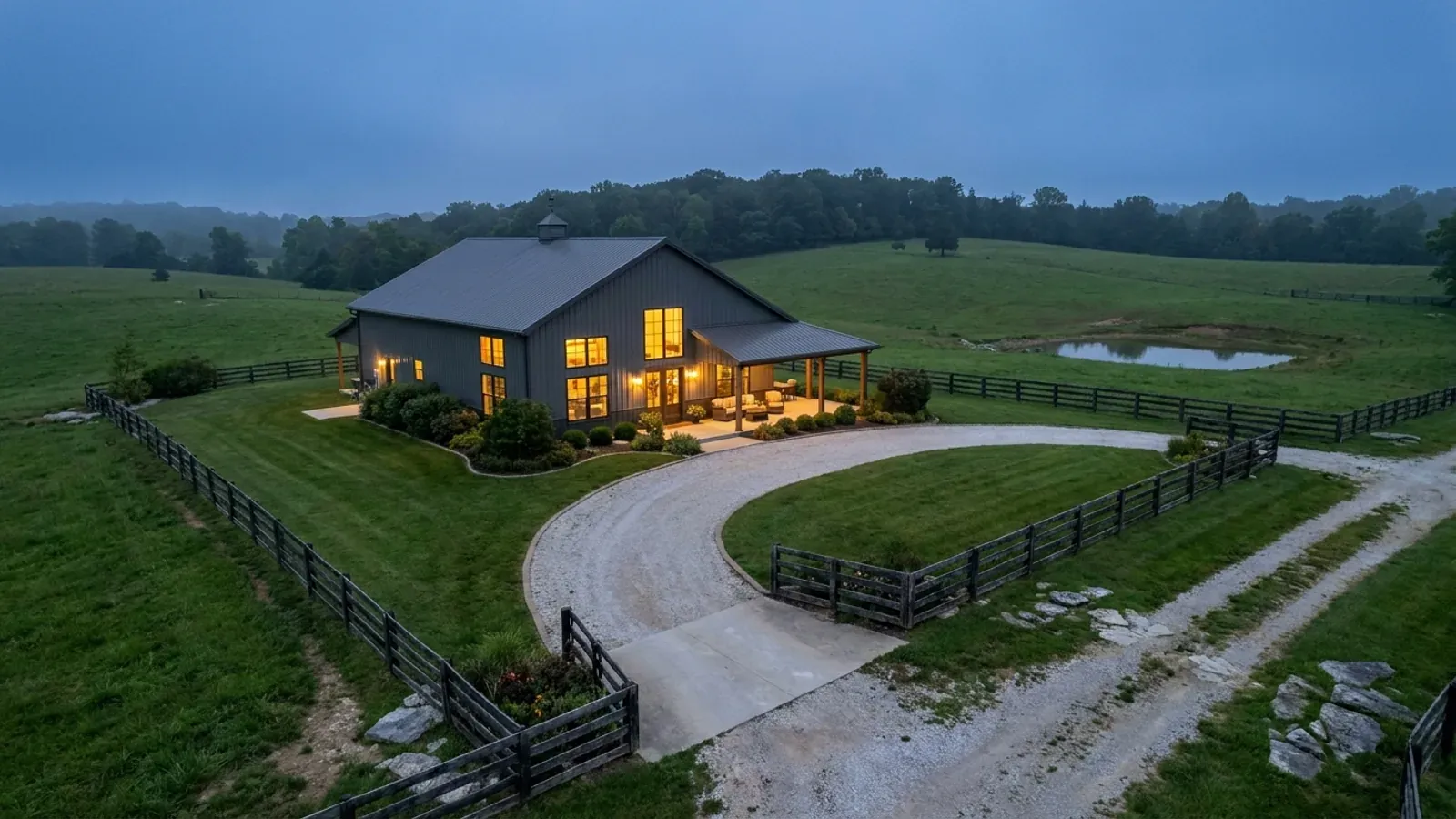
Frame to finish
Shell erected and dried in, then systems and interior finish — and the certified electrical inspection your utility needs before it will set a meter.
Those are the rules where you are building in Nelson County. Tell us what you want to build and we will draw it to them.
Where we build around Nelson County
Nelson and the rural land around it. The buildable acreage for a project this size usually sits outside the city limits, and in Kentucky that line frequently decides whether anyone issues a permit at all, not merely who issues it.
Keep reading
The questions that usually come next once you know what Nelson County allows.
Barndominium Cost Guide
Why the published spread runs from one end of the scale to the other, and which of it is the building rather than the ground.
Read itIs It Legal in Kentucky?
Whether your county inspects a house at all, what the farm-dwelling exemption really requires, and the approvals that reach you anyway.
Read itWhat a Pole Barn Home Costs
Post-frame against stick-built, and what the prescriptive post-frame section of the state code does and does not cover.
Read itNearby areas we build in
Others we cover nearby. They share the same statewide code and the same state-published design tables — but whether a house is permitted and inspected at all, whether the county zones, what the health department will accept for septic, and what the ground does to a foundation can all differ from one card to the next. Two counties that touch are not two versions of the same answer.
Building in Nelson County: common questions
11 questions we get asked most often about building in Nelson County. If yours is not on the list, ask it directly.
Do I need a building permit to put up a barndominium in Nelson County?
Can I build a shop bigger than the house, or build the shop first?
How much land do I need in Nelson County?
What does the Knobs terrain mean for my foundation?
What structural design figures does a Nelson County build have to meet?
Who issues the septic permit, and when does it have to be done?
My site touches a creek — what do I have to do?
Does the bourbon industry affect where I can build?
What will the permits cost me in Nelson County?
Do I need a contractor's licence to build in Nelson County?
Is Nelson County a good place to find acreage, or should I look elsewhere?
Building in Nelson County?
Start with the plan. Tell us what you want to build and we will draw it, then confirm whether any office permits and inspects a house where your parcel is, what it will let you put there, and which line of the state's snow, frost and seismic tables your county falls on. That conversation costs nothing.