Barndominium Builders in Boone County, KY
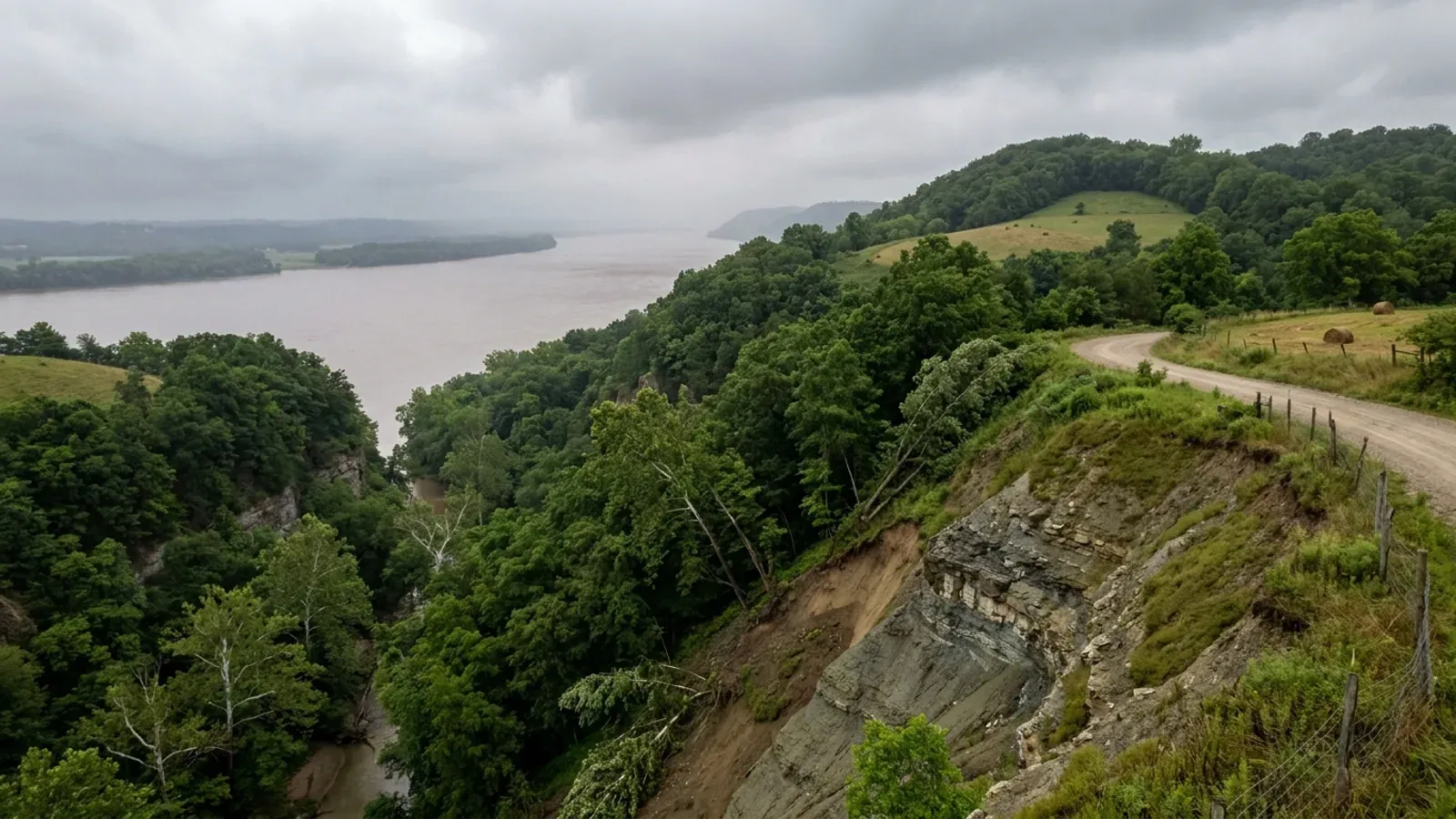
Boone County is counter-intuitive on three separate technical axes, and every one of them is checkable. It is one of only three Kentucky counties the Kentucky Residential Code's Table R301.2.2.1 assigns Seismic Design Category A — the lowest published anywhere in the Commonwealth, against B across most of the state and D2 in the Jackson Purchase. It is one of only three counties named in Table R401.4.1 footnote c, the code's only local bearing-capacity amendment, which raises the presumptive load-bearing value for CL and CH clays to 2,000 psf where the general table would give 1,500. And it sits near the top of the Kentucky Geological Survey's landslide inventory — above most Appalachian counties — because the Ordovician Kope Formation shale and limestone that forms the Ohio River hills here is the second most landslide-prone unit in the state's records. Administratively Boone is unusually simple for Kentucky: the Boone County Building Department covers the whole county including Florence, Union and Walton, it names the 2018 Kentucky Residential Code as the standard for all residential work, and there is no city line that changes the answer the way Somerset's does in Pulaski. What it does not have is a contractor registration. The county's own contractor guide asks for zoning approval, the permit, an occupational licence and workers' compensation, and nothing resembling the licence board Bowling Green and Warren County run jointly. On land, be honest: at 553 people per square mile Boone is the fourth-largest county in Kentucky by population on 246 square miles, and the rural south and west — Verona, Petersburg, Belleview, Big Bone — still holds 71,293 acres in farms, but that acreage fell nine percent in five years and A-1 zoning rations it at one dwelling per five acres. If the search is for volume acreage rather than a specific Boone parcel, Grant County down I-71/I-75 is the answer.
Boone County at a glance
- County
- Boone
- Population
- 147,142
- ZIP codes
- 41005, 41042, 41048, 41080, 41091, 41092, 41094
- Site visits
- Same day
Building conditions in Boone County
The building code is the same in every Kentucky county, and no local government may adopt or enforce a different one on a house — the Kentucky Residential Code says so in its own text. The design criteria are settled by the state too: the code prints a filled-in table covering all 120 counties, so your county's ground snow load, frost depth and seismic design category are published figures rather than something a local office decides. Ultimate design wind speed is 115 mph for every county in the state.
What changes from one county to the next is whether anyone checks. Kentucky makes permits, inspections and certificates of occupancy optional for a single-family home unless the local government has passed an ordinance requiring them, and it forbids the state from stepping in where none has. Twenty-five counties tell the state outright that they have no local building inspector, and in much of the rest the answer depends on an ordinance the county either passed or never did. Zoning is a separate, equally local choice — most Kentucky counties have never adopted any. What is below covers this county specifically: who issues the permit if anyone does, what the state's tables assign it, and what the ground does to a slab.
https://dhbc.ky.gov/Documents/2018%20Kentucky%20Residential%20Code%203d%20Ed.pdf — Table R401.4.1, PRESUMPTIVE LOAD-BEARING VALUES OF FOUNDATION MATERIALS, footnotes b and c; transcribed in research/statewide/soils-karst-and-slopes.md §6 and research/statewide/design-criteria-and-climate.md §5 · https://websoilsurvey.nrcs.usda.gov/app/ (the engineering-properties report is where a parcel's USCS symbol comes from)
https://dhbc.ky.gov/Documents/2018%20Kentucky%20Residential%20Code%203d%20Ed.pdf — Table R301.2.2.1 Seismic Design Categories–Site Class D, Table R301.2(1) ground snow load, Table R403.1.4 Minimum Frost Protection Depth for Kentucky; all three transcribed per county in research/statewide/design-criteria-and-climate.md
https://kgs.uky.edu/kgsweb/olops/pub/kgs/ic31_12.pdf (KGS IC-31, Crawford 2014 — Figure 11 county ranking and Table 5 formation counts; the per-county landslide counts other than Perry's peak are not legible from the extracted figure, so no number is given per county here) · https://www.uky.edu/KGS/water/library/gwatlas/Boone/Geology.htm (Kope Formation at the surface in Boone County) · https://kgs.uky.edu/arcgis/rest/services/Hazards/LandslideSusceptibility/MapServer/info/iteminfo (the 13-county coverage and KGS's own caveats)
https://dhbc.ky.gov/Documents/Boone%20County.pdf (DHBC county sheet, updated 7/30/2026 — text extracted and read 6 Sep 2026; note that this directory is a contact list and not a register of ordinances, which is why the county's own pages below are the load-bearing evidence) · https://www.boonecountyky.org/services/building_department/codes_policies.php · https://www.boonecountyky.org/services/building_department/inspections/index.php · https://apps.legislature.ky.gov/law/statutes/statute.aspx?id=52659
https://online.encodeplus.com/regs/boonecounty-ky/doc-viewer.aspx — Boone County Zoning Regulations, Table 31-1 (read 6 Sep 2026 via the regulations' own quick-tables service), SECTION 3110 Controls Applicable to Districts, Section 601.3 Intensity, Section 601.4 Minimum Standards; effective 12/20/2022 · https://www.boonecountyky.org/planning_commission/
https://online.encodeplus.com/regs/boonecounty-ky/doc-view.aspx?secid=2480 — Boone County Zoning Regulations SECTION 3153, Location of Accessory Structures or Uses, paragraphs A, B and C (read 6 Sep 2026; effective 12/20/2022) · https://online.encodeplus.com/regs/boonecounty-ky/doc-view.aspx?secid=2468 — SECTION 3115, Exemptions for Agricultural Purposes
Also worth knowing before you build in Boone County
- Boone County requires no contractor registration — and Bowling Green shows what that is worth
- Kentucky issues no state contractor licence for residential general contracting, and Boone County adds nothing on top of that. The county publishes its own quick guide to what a contractor must do before starting any job in Boone County, and it runs to five steps: contact the Planning Commission to confirm zoning approval, get the right permit, check whether an occupational licence is needed, verify insurance, and have the job details ready. There is no registration step, no competency exam, no bond and no county contractor card anywhere in it. The occupational licence is a revenue matter, not a credential — the county's own threshold is projects lasting more than three days or valued over $5,000, through the Occupational License department on 859-334-2144. Insurance is the one real gate: workers' compensation, or documentation if exempt, plus liability insurance appropriate for the project, and the department asks to be told upfront if a contractor or subcontractor does not require workers' comp so the correct paperwork can be filed. Set that against Bowling Green and Warren County, which run a joint licence board with a General contractor licence at $250, a Specialty licence at $100 and a $100,000 general liability minimum. Same state, same statute, entirely different front door.
- A zoning permit comes before the building permit, and the plot plan wants two-foot contours
- Boone County runs a two-agency sequence that catches people who expect one window. The Boone County Planning Commission's zoning permit application states that it shall be submitted in conjunction with a building permit application from the Boone County Building Department, and that a zoning permit must be issued before a building permit can be granted. The Zoning Administrator has seven days to approve or deny; the approved permit is posted on the job site; and if work has not begun within two years of issuance the permit expires, extendable on request before expiry. The published fee lines on the form are $90.00 and $45.00, with a checkbox marked Farm Exempt (No Fee). Four copies of the plot plan go with it, and the residential dwelling unit version asks for something a rural builder often has not budgeted: accurate existing topography at a minimum two-foot contour interval, from GIS data or a field survey, unless an approved grading or improvement plan less than five years old can supply it. The same checklist wants the location and approximate distance of any creek, stream or river; an approved encroachment permit for a new curb cut, from Boone County Public Works on 859-334-3600 for unincorporated land and Walton, the City of Union on 859-384-1511, the City of Florence on 859-647-5416, or the Kentucky Transportation Cabinet on 859-341-2700 for a state road; and, for a private system, a copy of the approved on-site septic permit from the Northern Kentucky Health District.
- Boone runs its own planning commission — it is not inside Kenton County's PDS
- Northern Kentucky has a well-known joint planning body, and it is worth knowing that Boone County is not in it. Planning and Development Services of Kenton County describes itself as a public agency serving Kenton County and its 19 cities, and DHBC's Kenton County sheet is the most fragmented in the state, with the cities of Erlanger, Bromley and Independence each running their own inspection programme and PDS covering the rest including unincorporated Kenton County. Boone County's arrangement is the opposite: a single county building department covering Burlington, Hebron, Petersburg, Verona and every other unincorporated community along with all three incorporated cities, and a Boone County Planning Commission that is a separate agency from the Boone County Fiscal Court, reached on 859-334-2196. For a buyer comparing parcels across the Kenton–Boone line, that is a genuine administrative difference: in Boone the answer to who permits this is one office regardless of address, and in Kenton it depends which side of a municipal boundary the parcel falls on.
- One health department covers Boone, Campbell, Grant and Kenton — and the septic permit gates the zoning permit
- Kentucky's on-site sewage permits are issued locally by a certified inspector at the health department having jurisdiction, under 902 KAR 10:110, with the state cabinet writing 902 KAR 10:085 and certifying the inspectors and installers. For Boone County that department is the Northern Kentucky Health Department, which covers Boone, Campbell, Grant and Kenton counties from 8001 Veterans Memorial Drive in Florence, 859-341-4264. The published sequence is an application with a site survey, property dimensions and the proposed system location, a $300 evaluation fee, soil testing, and then — only if the site rates suitable or provisionally suitable overall — a certified installer applying for the installation permit; the installer must request an inspection before any of the work is covered. What makes this a Boone-specific sequencing problem rather than a general one is that the county's zoning permit application for a residential dwelling unit lists the approved on-site septic permit as a required attachment. So on a parcel with no sewer, the health department's soil work has to be finished before the Planning Commission will issue a zoning permit, and the zoning permit has to issue before the Building Department will grant a building permit. Three approvals in a fixed order, and the first of them depends on what a soil pit shows.
- The Ohio River frontage, and the state permit that stacks on the county's
- Boone County fronts the Ohio for the length of its northern and western boundary, from Constance round past Petersburg, and the flood picture is administered rather than ignored. FEMA's Community Status Book for Kentucky lists unincorporated Boone County (CID 210013), the City of Florence (210238), the City of Union (210270) and the City of Walton (210379) as participating in the National Flood Insurance Program, all four on a current effective map dated 21 March 2023 — a recent remap, which is worth knowing because a parcel's flood zone may have changed since the last time anyone looked. Participation means the county maintains a flood damage prevention ordinance and reviews local floodplain permits. The county's own zoning permit checklist puts the requirement in the applicant's hands: the plot plan must show the 100-year flood level, and if any part of the parcel is in a designated 100-year floodplain, or near a blue-line stream with a tributary area of one square mile or greater and no designated flood elevations on the adopted maps, then either a Stream Construction Permit from the Water Resources Branch or the approval of the Local Floodplain Coordinator must be provided. On top of whatever the county requires, Kentucky requires a separate state Division of Water floodplain construction permit for work in the base floodplain under KRS 151.250 and 401 KAR 4:060 §2, on form DOW 7116 — the state permit stacks on the local one rather than replacing it.
- 727 farms and 71,293 acres — but the acreage fell nine percent in five years
- USDA's 2022 Census of Agriculture county profile for Boone counts 727 farms across 71,293 acres, averaging 98 acres. On a county of 246 square miles that is about 45 percent of the land area still in farms, which is more than the 553-people-per-square-mile headline suggests, because the density is concentrated in Florence, Hebron and the Union corridor while the south and west of the county stays rural. The size distribution: 79 farms of 1 to 9 acres, 349 of 10 to 49, 214 of 50 to 179, 49 of 180 to 499, 25 of 500 to 999 and 11 at 1,000 acres or more. Land use splits 26,443 acres cropland, 18,921 pastureland and 20,737 woodland. The direction of travel is the part to be honest about: land in farms fell 9 percent and average farm size fell 10 percent between 2017 and 2022, in Kentucky's fifth-fastest-growing county. Grant County, one exit further down I-71/I-75, tells a different story on the same measure — 787 farms across 84,737 acres at an average of 108, with 362 farms in the 50-to-179-acre band against Boone's 214 and 97 in the 180-to-499 band against Boone's 49, spread over 260 square miles at 96 people per square mile. If the requirement is a specific Boone parcel, Boone still has farmland. If the requirement is acreage at a workable price, Grant County is the honest answer and it is a 30 to 45 minute drive from Florence.
- Radon Zone 2, no named karst area, no mine subsidence fund — and a county hillside rule instead
- Boone County's ground hazards are not the ones the rest of Kentucky worries about. It is not in any of the five karst areas the Kentucky Geological Survey names in its groundwater atlas — Western Pennyroyal, Inner Bluegrass, Eastern Pennyroyal, Carter Caves and Pine Mountain — and the bedrock at the surface here is the Kope Formation, Late Ordovician shale and limestone, not the thick soluble carbonate that makes sinkhole country. It is not one of the 37 counties whose fiscal courts voted into the Kentucky Mine Subsidence Insurance Fund, so the automatic endorsement under KRS 304.44-030 does not attach to a Boone policy. And on EPA's Map of Radon Zones it falls in Zone 2, moderate potential, rather than the Zone 1 belt that runs through the Inner Bluegrass and the Pennyroyal — a lower class than Pulaski or Fayette, though EPA's own caveat is that the map should not be used to decide whether an individual home needs testing, and the Kentucky Residential Code adopts appendices K, R and S and not Appendix F, so radon-resistant construction is nowhere required in Kentucky and a passive sub-slab rough-in is a cheap choice while the slab is open. What Boone does have is slope, and the county wrote its own rule for it: Section 3162 Hillside Development Guidelines applies to slopes of 20 percent or greater and to soil types identified as having development limitations in the Boone County Comprehensive Plan or the Soil Survey of Boone, Campbell and Kenton Counties. Those guidelines are applied by the Planning Commission at major subdivision, site plan, zoning map amendment and concept development plan review rather than at a single-lot permit, and they are guidelines — but they tell you what the county already knows about its own ground, including the instruction to respect the site's steepness, soil, bedrock and hydrology to ensure hillside stability during and after development, and to control post-development stormwater that could affect adjacent steep slopes.
https://www.boonecountyky.org/services/building_department/contractors/index.php (Boone County Building Department contractor guide, read 6 Sep 2026; the same five-step text appears in the Internet Archive capture at http://web.archive.org/web/20260814181420/https://boonecountyky.org/services/building_department/contractors/ — no contractor registration step appears in either) · research/statewide/contractor-licensing.md §3.5 and §3.7 for the Bowling Green–Warren County comparison
https://www.boonecountyky.org/Documents/Services/Building%20Department/Building%20Permits/ZoningPermitRes.pdf (Boone County Planning Commission zoning permit application, residential dwelling units — text extracted and read 6 Sep 2026) · https://www.boonecountyky.org/Documents/Services/Building%20Department/Homeowners/ZoningPermitAcc.pdf (the accessory-structures version, which the county's homeowners page points at for sheds and pole barns) · https://www.boonecountyky.org/services/building_department/homeowners/index.php
https://www.pdskc.org/about/ (PDS states it serves Kenton County and its 19 cities; note that other PDS endpoints have refused automated access in this project — the contractor-licensing research recorded a 404 on the PDS building-codes FAQ and a 403 from the pdskc.govbuilt.com licensed-contractors portal, so nothing here is asserted about PDS contractor requirements) · https://dhbc.ky.gov/Documents/Boone%20County.pdf · https://www.boonecountyky.org/services/building_department/contractors/index.php · research/statewide/code-regime.md §4
https://nkyhealth.org/septic/ (counties served, evaluation fee and permit sequence, read 6 Sep 2026) · https://www.boonecountyky.org/Documents/Services/Building%20Department/Building%20Permits/ZoningPermitRes.pdf (item 21, approved on-site septic permit required with the zoning permit) · https://apps.legislature.ky.gov/law/kar/titles/902/010/085/ · https://apps.legislature.ky.gov/law/kar/titles/902/010/110/
https://www.fema.gov/cis/KY.html (Kentucky Community Status Book, read 6 Sep 2026 — the host refuses direct automated requests, so the Boone County rows were read through the fetch service) · https://www.boonecountyky.org/Documents/Services/Building%20Department/Building%20Permits/ZoningPermitRes.pdf (item 22) · https://apps.legislature.ky.gov/law/statutes/statute.aspx?id=54097 · https://eec.ky.gov/Environmental-Protection/Water/FloodDrought/Pages/UnderstandYourFloodHazards.aspx
https://www.nass.usda.gov/Publications/AgCensus/2022/Online_Resources/County_Profiles/Kentucky/cp21015.pdf (2022 Census of Agriculture, Boone County profile — text extracted and read 6 Sep 2026) · https://www.nass.usda.gov/Publications/AgCensus/2022/Online_Resources/County_Profiles/Kentucky/cp21081.pdf (Grant County profile, same run) · research/statewide/geography-and-population.md for the county land areas and densities
https://online.encodeplus.com/regs/boonecounty-ky/doc-view.aspx?secid=2489 — Boone County Zoning Regulations SECTION 3162, Hillside Development Guidelines (read 6 Sep 2026) · https://www.uky.edu/KGS/water/library/gwatlas/wprkarst.html (the five named karst areas) · https://www.uky.edu/KGS/water/library/gwatlas/Boone/Geology.htm · https://insurance.ky.gov/PPC/Documents/JAN%202025_Revised%20Mine%20Subsidence%20Insurance%20Fund%20080124.pdf (the 37-county list; Boone is not on it) · https://www.epa.gov/sites/default/files/2014-08/documents/kentucky.pdf and https://radonlevels.org/state/ky (the EPA map is a graphic and the county colour assignments do not extract from it; the Zone 2 placement for Boone is taken from a third-party rendering of that map and should be re-checked against EPA before anyone relies on it) · https://kgs.uky.edu/kygeode/geomap?gkarst=true
The expensive surprises are in the ground, not the building
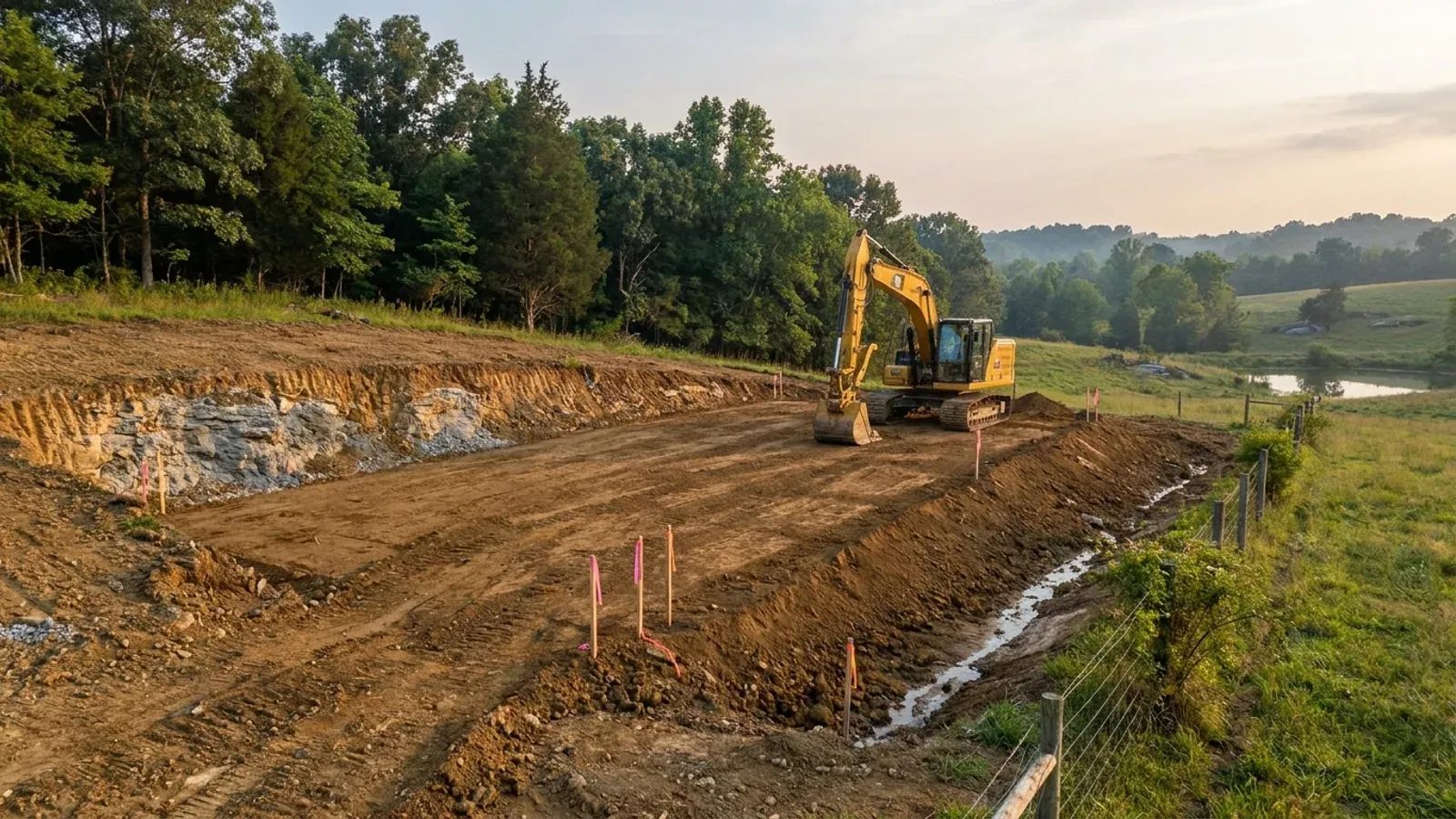
What moves a Kentucky budget is usually below grade, and more often than not it is what the ground is sitting on rather than the ground itself. The Kentucky Geological Survey says 92 of the state's 120 counties contain karst — limestone that dissolves — across four named areas: the Western Pennyroyal around Bowling Green and Hopkinsville, the Inner Bluegrass around Lexington, the Eastern Pennyroyal through Somerset and Monticello, and Pine Mountain in the south-east. On karst, KGS's own model ordinance for local governments lists the structures that should not be sited in sinkhole areas, and the list is buildings with soil-bearing foundations and buildings that cover thousands of square feet with impermeable surface. A post-frame or steel building on a monolithic slab is both of those at once. KGS is equally clear that nearly all karst parcels still have buildable ground on them — so karst does not stop the build, it removes the option of siting the pad by eye. A filled and graded-over sinkhole is the classic trap, because the pad looks perfect.
In the two coal fields the question is undermining instead, and Kentucky treats it differently from everything else: mine subsidence coverage is added automatically to property policies in the counties whose fiscal court voted the fund in, with a written opt-out — thirty-seven of them — while karst collapse gets no fund at all and falls under the ordinary earth-movement exclusion. On slopes the surprise is geographic: KGS's landslide inventory puts Kenton, Campbell, Boone and Gallatin — the northern Kentucky counties opposite Cincinnati — near the very top, above most Appalachian counties, on Ordovician shale. Three of those four — Boone, Campbell and Kenton — are the only counties in the state with a line of their own in the residential code's bearing table, which raises the presumptive value for two named clay groups there and nowhere else. Everywhere else the table gives clay and silt a single presumptive figure, and a soils investigation becomes mandatory once the building official determines the real capacity is likely to be lower than it.
The same ground then sizes the septic system, and Kentucky does that from soil morphology — a certified inspector reading the profile in a backhoe pit — rather than from a percolation test, at 110 gallons a day per bedroom against an application rate taken from soil texture and structure. On a mound or other alternative design a measured permeability test can still be required. And on karst the septic regulation is blunter than the building code ever gets: it declares the ground within seventy feet of an open sinkhole throat unsuitable outright. The soil that needs a foundation engineer is usually the soil that complicates the drainfield, so the site work, the foundation and the septic get resolved together rather than one at a time. We price the dirt before we price the building.
What we build in Boone County
All seven services are available in Boone County. What a build costs depends far more on the parcel than on square footage, so we price against your land rather than publishing a rate card.
Barndominium Kits
We check barndominium kit packages against the wind, snow, frost and seismic criteria the Kentucky Residential Code publishes for your county.
Pole Barn Homes
Pole barn homes across Kentucky. KRC §R327 covers accessory barns, not houses — so a pole barn home is engineered by the code's own terms.
Custom Barndominium Plans
Barndominium plans drawn to Kentucky's published county design criteria — snow, wind, seismic, frost — with engineering where the code calls for it.
What a build looks like
Three stages every Boone County project passes through, from a raw parcel to a finished home. Site work first, because that is where the budget is decided.
The parcel
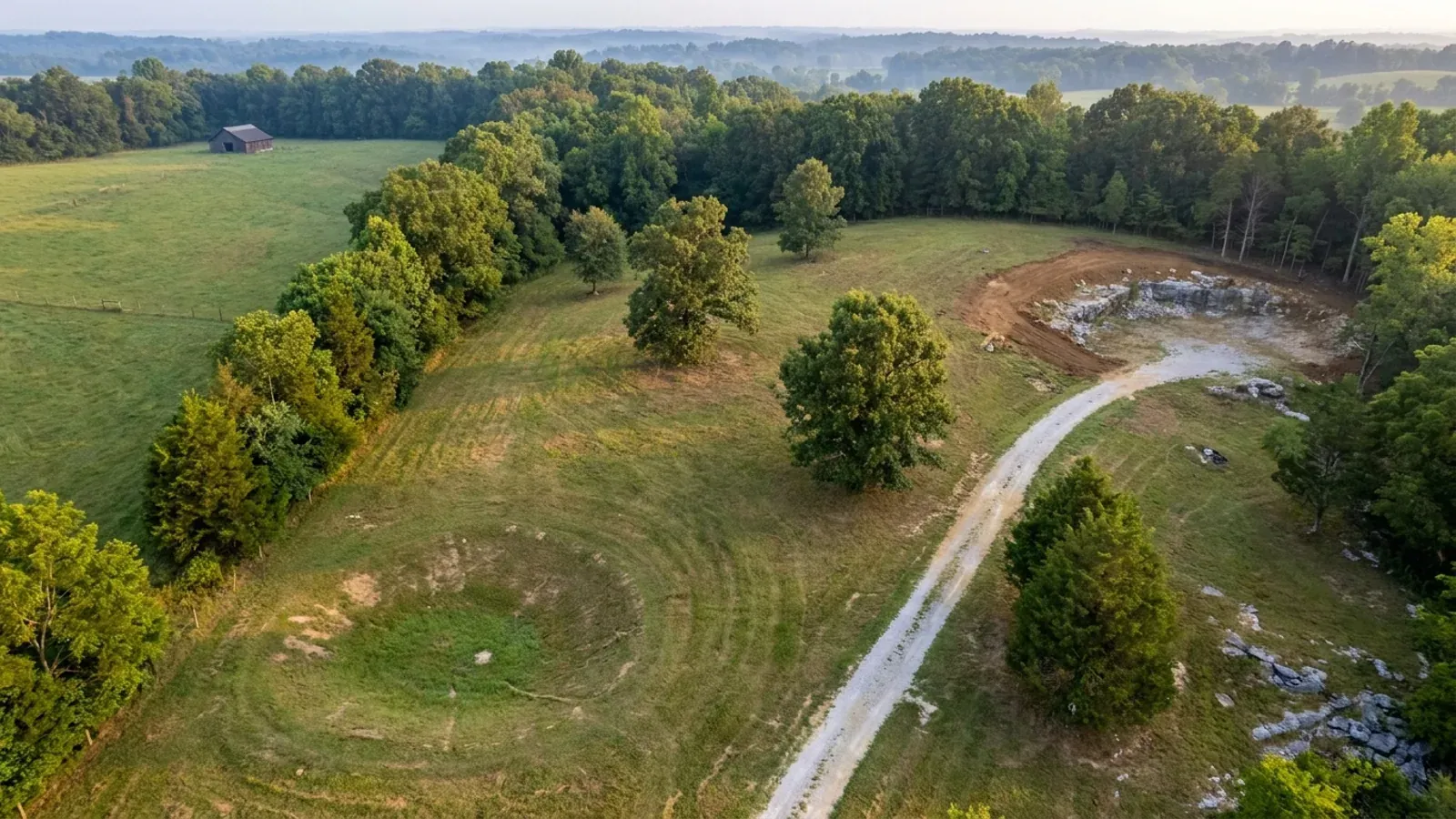
Karst and mine maps, the flood question, zoning where the county has any, and utility access — all checked before anything is drawn.
Pad and permit
Clearing, grading and a compacted pad, while the submittal works through whichever office issues the permit — and where no office does, through the approvals that still apply.
Frame to finish
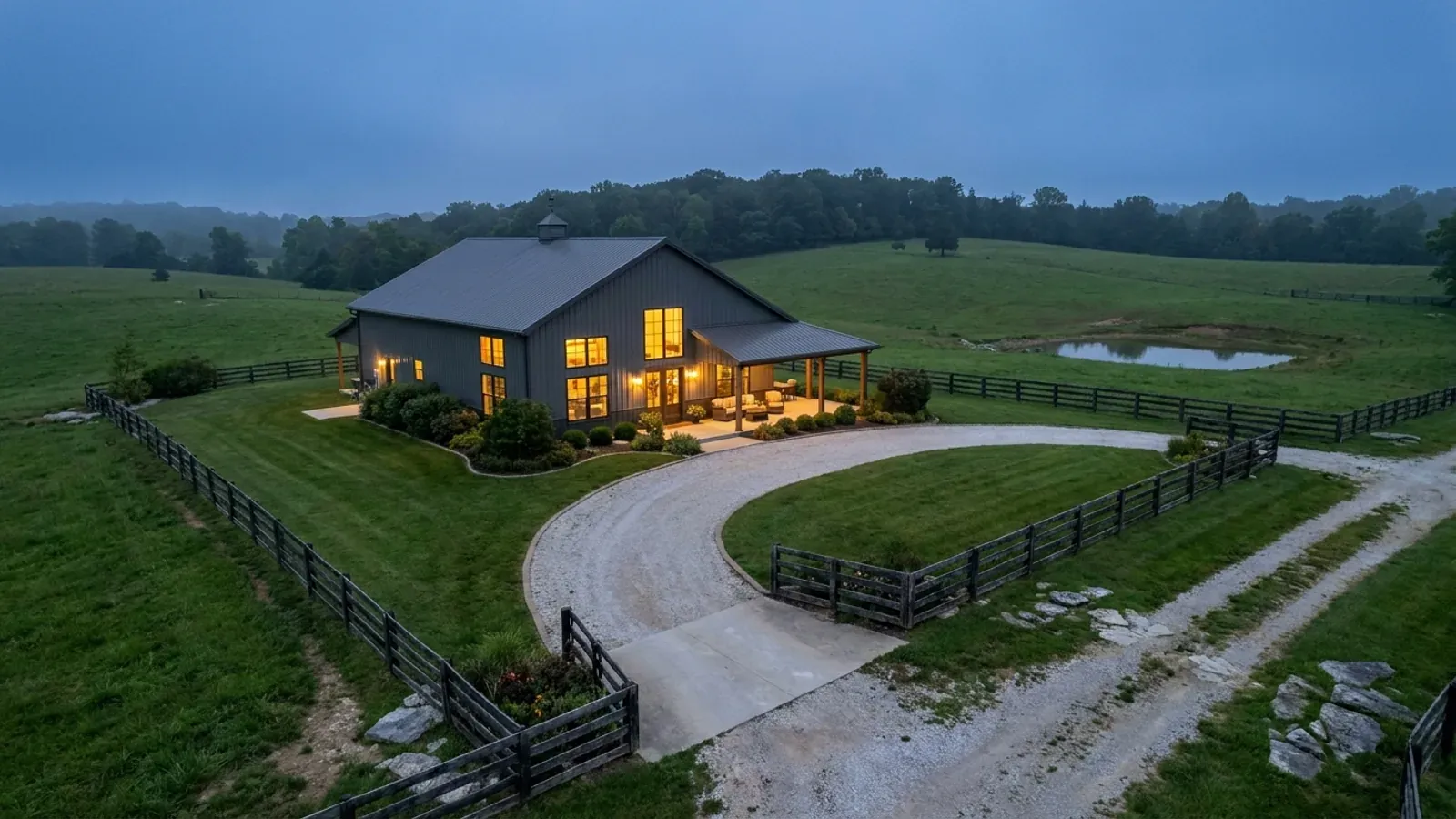
Shell erected and dried in, then systems and interior finish — and the certified electrical inspection your utility needs before it will set a meter.
Those are the rules where you are building in Boone County. Tell us what you want to build and we will draw it to them.
Where we build around Boone County
Boone and the rural land around it. The buildable acreage for a project this size usually sits outside the city limits, and in Kentucky that line frequently decides whether anyone issues a permit at all, not merely who issues it.
Keep reading
The questions that usually come next once you know what Boone County allows.
Barndominium Cost Guide
Why the published spread runs from one end of the scale to the other, and which of it is the building rather than the ground.
Read itIs It Legal in Kentucky?
Whether your county inspects a house at all, what the farm-dwelling exemption really requires, and the approvals that reach you anyway.
Read itWhat a Pole Barn Home Costs
Post-frame against stick-built, and what the prescriptive post-frame section of the state code does and does not cover.
Read itNearby areas we build in
Others we cover nearby. They share the same statewide code and the same state-published design tables — but whether a house is permitted and inspected at all, whether the county zones, what the health department will accept for septic, and what the ground does to a foundation can all differ from one card to the next. Two counties that touch are not two versions of the same answer.
Building in Boone County: common questions
8 questions we get asked most often about building in Boone County. If yours is not on the list, ask it directly.
Do I need a building permit for a barndominium in Boone County?
Can I build a shop bigger than the house here?
What design figures does a Boone County build have to meet?
Do I need a contractor's licence to build in Boone County?
Is there really land to buy in Boone County?
Northern Kentucky has landslides? I thought that was an eastern Kentucky problem.
Who issues the septic permit, and where does it sit in the order of operations?
What about the Ohio River and flood zones?
Building in Boone County?
Start with the plan. Tell us what you want to build and we will draw it, then confirm whether any office permits and inspects a house where your parcel is, what it will let you put there, and which line of the state's snow, frost and seismic tables your county falls on. That conversation costs nothing.