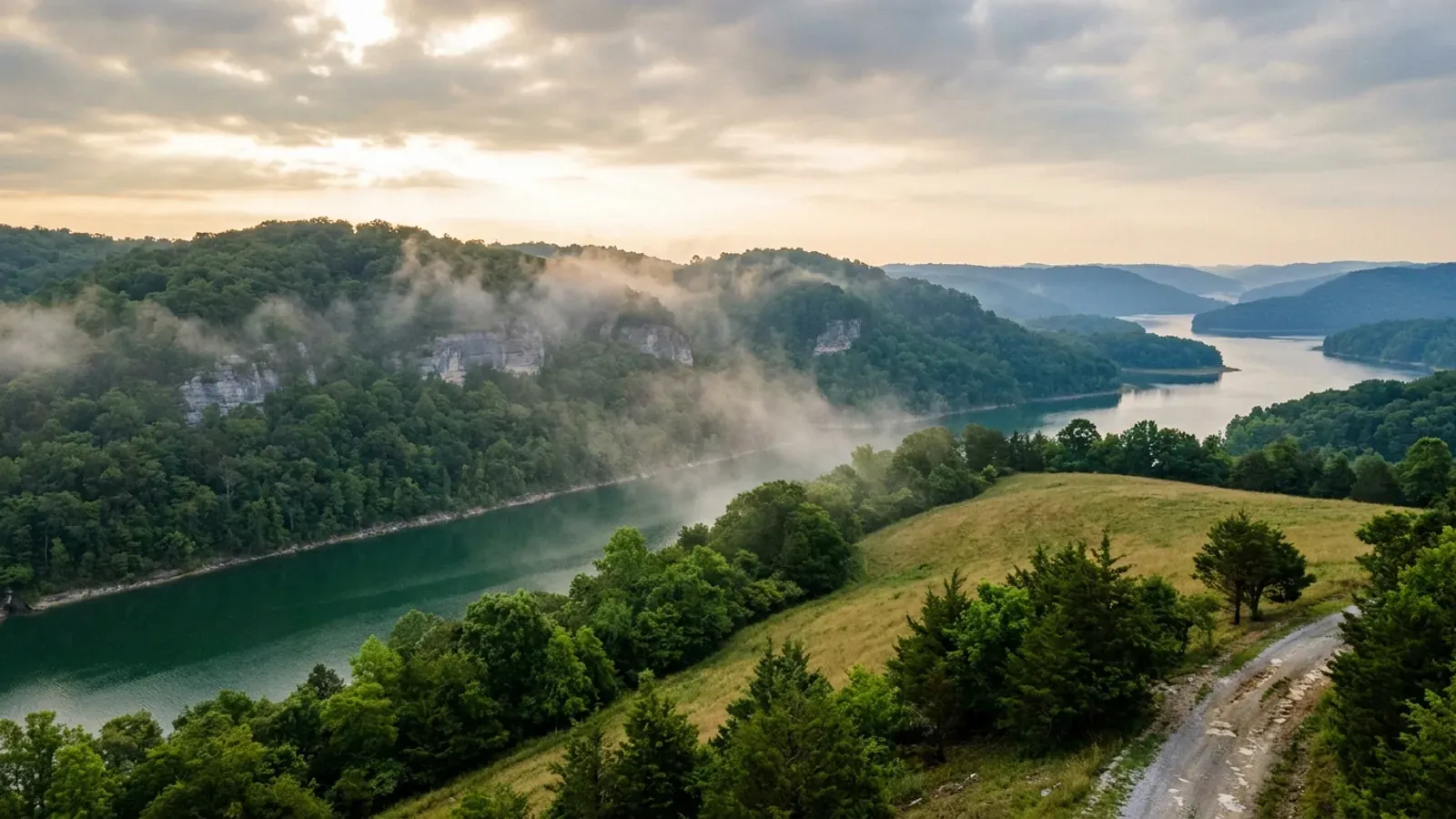
Barndominium Builders in Pulaski County, KY
Pulaski County is the company's home county, and it is also one of the two or three best acreage counties in Kentucky on the evidence: 662 square miles at 98 people per square mile, 1,600 farms — second-most of any Kentucky county — and 200,962 acres in farms at an average of 126 acres each. The thing a buyer here has to get right is not the ground, it is the line. Pulaski County's own government publishes that the county has no zoning laws, does not require a building permit for residential construction, and does not issue certificates of occupancy; its building inspector is titled the County Commercial Building Inspector. Cross into Somerset and the answer reverses completely — the City of Somerset runs a state-certified Building Inspection Department that regulates all residential and commercial construction, issues permits, reviews plans and withholds the certificate of occupancy until as-built drawings are in. Two neighbours a mile apart, one of them permitted and inspected and one of them not. What binds on both sides of that line is the septic permit, which the Lake Cumberland District Health Department gates on a minimum lot of 22,000 square feet, and the electrical certificate, without which no utility may set a meter.
Pulaski County at a glance
- County
- Pulaski
- Population
- 67,809
- ZIP codes
- 42501, 42502, 42503, 42518, 42519, 42533, 42544, 42553, 42564, 42567
- Site visits
- Same day
Building conditions in Pulaski County
The building code is the same in every Kentucky county, and no local government may adopt or enforce a different one on a house — the Kentucky Residential Code says so in its own text. The design criteria are settled by the state too: the code prints a filled-in table covering all 120 counties, so your county's ground snow load, frost depth and seismic design category are published figures rather than something a local office decides. Ultimate design wind speed is 115 mph for every county in the state.
What changes from one county to the next is whether anyone checks. Kentucky makes permits, inspections and certificates of occupancy optional for a single-family home unless the local government has passed an ordinance requiring them, and it forbids the state from stepping in where none has. Twenty-five counties tell the state outright that they have no local building inspector, and in much of the rest the answer depends on an ordinance the county either passed or never did. Zoning is a separate, equally local choice — most Kentucky counties have never adopted any. What is below covers this county specifically: who issues the permit if anyone does, what the state's tables assign it, and what the ground does to a slab.
https://www.pulaskigov.com/county-government/ (department listing, read 5 Sep 2026 — the live host refuses automated requests behind a Wordfence block, so the text was read from the Internet Archive capture at http://web.archive.org/web/20260905125721/https://www.pulaskigov.com/county-government/) · https://www.cityofsomerset.com/building-inspection/ · https://www.cityofsomerset.com/wp-content/uploads/2022/01/Building-Permit-Application-2022.pdf · https://apps.legislature.ky.gov/law/statutes/statute.aspx?id=52659
https://www.pulaskigov.com/ordinances/ (county ordinance index, read 5 Sep 2026 via the Internet Archive capture at http://web.archive.org/web/20260905125757/https://www.pulaskigov.com/ordinances/ — the live host blocks automated access) · https://www.pulaskigov.com/county-government/ · KRS Chapter 100, https://apps.legislature.ky.gov/law/statutes/chapter.aspx?id=38316
https://www.nass.usda.gov/Publications/AgCensus/2022/Online_Resources/County_Profiles/Kentucky/cp21199.pdf (2022 Census of Agriculture, Pulaski County profile — text extracted and read 5 Sep 2026) · https://www.kyagr.com/ky-agnews/press-releases/2024/US-Census-of-Agriculture-shows-growth-for-Kentucky-agricultural-products.html
https://www.lcdhd.org/services/environmental-services/guidelines/lot-size-regulation-for-private-waste-water-disposal-systems/ (the live LCDHD host refuses automated connections from here — this reproduces a prior attempt — so the regulation text was read 5 Sep 2026 from the Internet Archive capture at http://web.archive.org/web/20260905124213/https://www.lcdhd.org/services/environmental-services/guidelines/lot-size-regulation-for-private-waste-water-disposal-systems/) · https://apps.legislature.ky.gov/law/kar/titles/902/010/085/
https://dhbc.ky.gov/Documents/2018%20Kentucky%20Residential%20Code%203d%20Ed.pdf — Table R301.2(1) (snow, wind, weathering, termite), Table R301.2.2.1 Seismic Design Categories–Site Class D, Table R403.1.4 Minimum Frost Protection Depth for Kentucky; transcribed in research/statewide/design-criteria-and-climate.md
https://www.uky.edu/KGS/water/library/gwatlas/wprkarst.html · https://www.epa.gov/sites/default/files/2014-08/documents/kentucky.pdf · https://kgs.uky.edu/kygeode/geomap?gkarst=true (KGS Karst Potential Index viewer, parcel-checkable) · https://apps.legislature.ky.gov/law/kar/titles/902/010/085/ · https://kygs.uky.edu/geology/radon
Also worth knowing before you build in Pulaski County
- Burnside is the one Pulaski community not in the flood program
- FEMA's Community Status Book for Kentucky lists unincorporated Pulaski County (CID 210197) and the City of Somerset (CID 210199) among communities participating in the National Flood Insurance Program — the county with an initial FIRM of 16 July 1990 and Somerset from 4 September 1985, both on a current effective map dated 22 July 2010. The City of Burnside (CID 210426) appears instead under communities not in the flood program, carrying a 22 July 2011 date. Burnside sits directly on Lake Cumberland at the mouth of the South Fork, which is precisely where a buyer is most likely to be looking at water frontage, and NFIP standing is what decides whether federally backed flood insurance can be written at all. The county's own ordinance index does list a Flood Insurance ordinance and a Flood Damage Prevention ordinance, which is what participation requires. On top of any local approval, Kentucky requires a separate state Division of Water floodplain permit for construction in the base floodplain under KRS 151.250 and 401 KAR 4:060 §2, applied for on form DOW 7116.
- Two occupational licences stack in Somerset, and every subcontractor buys their own
- The City of Somerset requires a business licence of anyone conducting business inside the city, on a licence year running 1 May to 30 April. Its contractor line is $150 for a local contractor and $200 for a non-local one, covering carpentry, electrical, plumbing, roofing, masonry and the related building trades — and the city's own answer to whether subcontractors need their own is that each contractor purchases his or her own licence. Separately, Pulaski County levies its own occupational licence fee through the Pulaski County Occupational Tax Office at 100 N. Main Street Suite 206, 606-679-2393, so a job inside the city sits under both. None of this is a competency licence: Kentucky issues no state contractor licence for residential general contracting, and neither the city nor the county tests or certifies a builder. It is a revenue licence, and a crew of five trades on a Somerset site means five of them.
- No building permit does not mean no inspection — the meter is the gate
- KRS 198B.060(11) provides that no utility may initiate permanent electrical service to a new building until a certified electrical inspector has issued a final certificate of approval. That reaches every parcel in Kentucky regardless of whether anyone inspects the structure. Pulaski County publishes four county electrical inspectors by name — Jackie Spears, Michael Ledger, Larry Strunk and Ron Ebling — and its ordinance index carries an Electrical Inspection Fee ordinance. DHBC's Pulaski sheet, updated 3 March 2026, additionally names a state electrical inspector, an HVAC inspector and a plumbing inspector, all at ky.gov addresses. The health department is in the same chain: the Lake Cumberland district issues a temporary electric sticker once the soil evaluation is written up and a permanent one once the installed septic system passes. No septic sign-off and no electrical certificate means no permanent power, whatever the county does or does not require on the building side.
- Pulaski is not a mine subsidence county, and Kentucky has no equivalent for karst
- Kentucky's Mine Subsidence Insurance Fund covers 37 counties whose fiscal courts voted the coverage in, and in those counties KRS 304.44-030 puts the endorsement on every property policy automatically unless the insured waives it in writing. Pulaski is not one of the 37, and neither are Wayne or Rockcastle — the fund maps the eastern and western coal fields, and Pulaski sits between them. That is a useful thing to know precisely, because the two hazards get merged in conversation and they are not the same. Karst is the Pulaski problem, and Kentucky built no statutory fund, no mandatory endorsement and no seller-disclosure question for it: the Kentucky Real Estate Commission's Form 402 asks about soil stability, drainage and erosion and asks nothing about sinkholes, caves or undermining. The standard homeowner's earth-movement exclusion is broad enough to swallow a karst collapse, so cover for it is a written question for an agent rather than an assumption.
- Inside Somerset: 15 cents a square foot to review, and a soil-disturbance threshold most people miss
- The City of Somerset's building permit application prices plan review by occupancy in cents per square foot, with residential at 15 cents; the $285 minimum non-refundable review deposit printed on the form is stated for commercial plan review. The checklist wants structural drawings where applicable, a site plan showing the building location and distances to adjacent buildings and property lines, a list of general contractors and subcontractors with contact information, and a certificate of insurance. Then it asks a question a rural builder rarely sees coming: total disturbed soil area. Under 750 square feet a sketch plan is enough. Between 750 square feet and one acre the city wants a professional plot plan, a standard SWPPP form and a named EPSC-certified contractor. Over one acre it adds a grading and drainage plan and Kentucky's general permit for construction stormwater discharges. A barndominium pad plus a long gravel drive crosses an acre of disturbance more easily than people expect. The form also requires City of Somerset gas, water and sewer sign-offs on utility locations.
- ZIP 42501 is wholly inside Pulaski County, and the company's own address is inside the city line
- A ZIP code is a mail route and does not respect a county boundary, so it is worth checking rather than assuming. ZIP 42501 is a standard street-delivery ZIP assigned to a single county, Pulaski, covering Somerset plus the Acorn, Alcalde, Elihu, Poplarville, Public, Ruth, Stab and Walnut Grove names. The company's own address at 1900 S Hwy 27 geocodes through the Census Bureau to Pulaski County (FIPS 21199) and to the incorporated place Somerset city (FIPS 2171688) — that is, inside the city limits, which puts it under the Somerset Building Inspection Department rather than the county. The match is a TIGER address-range interpolation rather than a surveyed parcel point, so a boundary-line parcel should still be checked against the city's own map. Do not generalise from 42501 to the rest of the county: several ZIPs delivering to Pulaski addresses also serve neighbouring counties, which is the whole reason the check is worth running per parcel rather than per ZIP.
https://www.fema.gov/cis/KY.html (Kentucky Community Status Book, read 5 Sep 2026) · https://www.pulaskigov.com/ordinances/ · https://apps.legislature.ky.gov/law/statutes/statute.aspx?id=54097 · https://eec.ky.gov/Environmental-Protection/Water/FloodDrought/Pages/default.aspx
https://www.cityofsomerset.com/business-licenses/ (fees and the subcontractor answer, read 5 Sep 2026) · https://tax.pulaskigov.com/ · https://www.pulaskigov.com/county-government/
https://apps.legislature.ky.gov/law/statutes/statute.aspx?id=52659 · https://dhbc.ky.gov/Documents/Pulaski%20County.pdf (sheet updated 3/3/2026, text extracted and read 5 Sep 2026) · https://www.pulaskigov.com/county-government/ · https://www.lcdhd.org/services/environmental-services/guidelines/new-home-on-site-sewage-disposal/ (LCDHD refuses automated connections; read via http://web.archive.org/web/20260905124358/https://www.lcdhd.org/services/environmental-services/guidelines/new-home-on-site-sewage-disposal/)
https://insurance.ky.gov/PPC/Documents/JAN%202025_Revised%20Mine%20Subsidence%20Insurance%20Fund%20080124.pdf · https://insurance.ky.gov/ppc/Documents/bulletin0904minesubs092109.pdf · https://krec.ky.gov/Documents/KREC%20Form%20402%20-%20Sellers%20Disclosure%20of%20Property%20Condition.pdf · https://minemaps.ky.gov/
https://www.cityofsomerset.com/wp-content/uploads/2022/01/Building-Permit-Application-2022.pdf (text extracted and read 5 Sep 2026) · https://www.cityofsomerset.com/building-inspection/
https://geocoding.geo.census.gov/geocoder/geographies/onelineaddress?address=1900+S+Highway+27,+Somerset,+KY+42501&benchmark=Public_AR_Current&vintage=Current_Current&format=json (raw JSON retrieved and read 5 Sep 2026) · https://www.zip-codes.com/m/zip-code/42501/zip-code-42501.asp
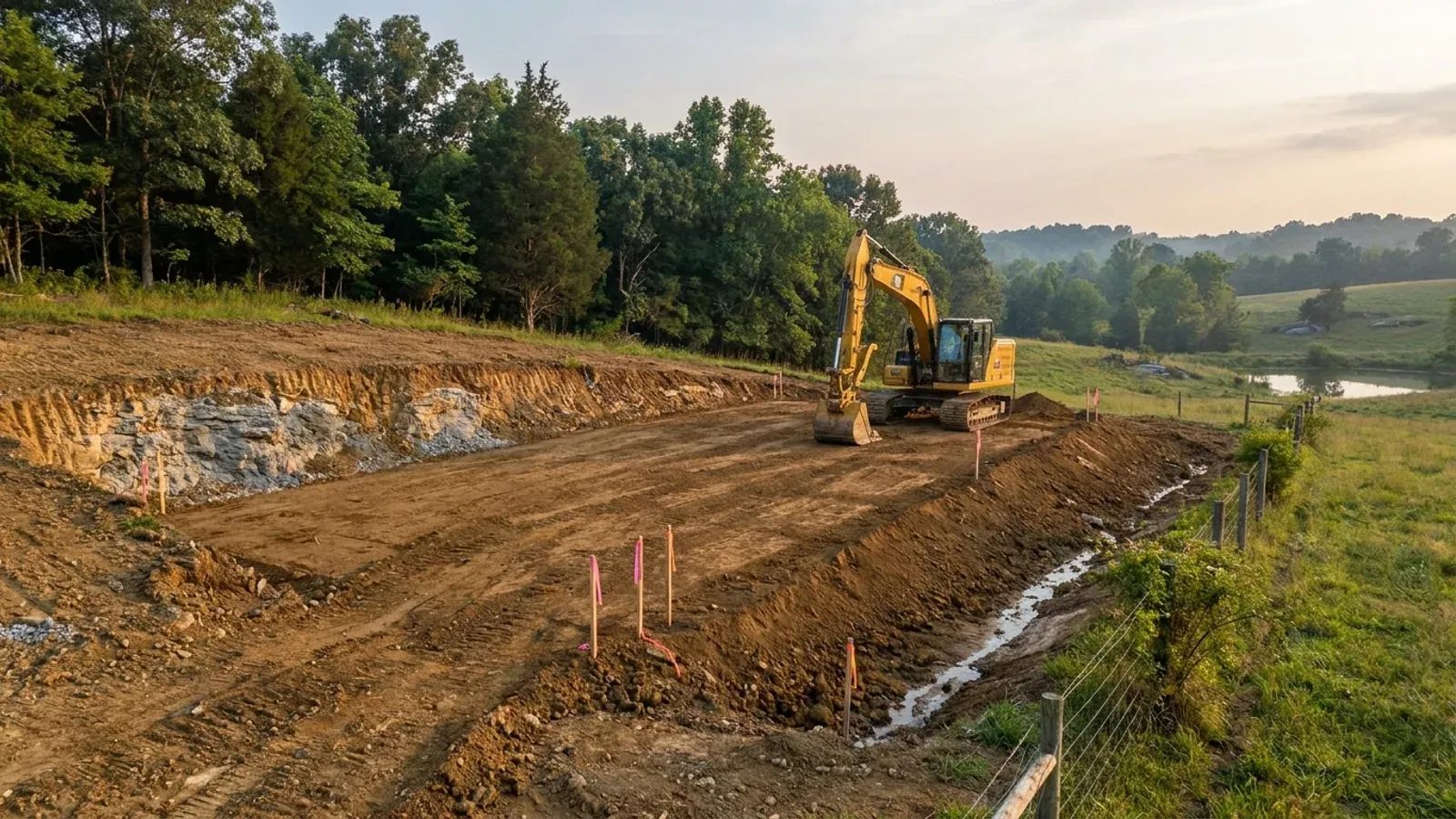
The expensive surprises are in the ground, not the building
What moves a Kentucky budget is usually below grade, and more often than not it is what the ground is sitting on rather than the ground itself. The Kentucky Geological Survey says 92 of the state's 120 counties contain karst — limestone that dissolves — across four named areas: the Western Pennyroyal around Bowling Green and Hopkinsville, the Inner Bluegrass around Lexington, the Eastern Pennyroyal through Somerset and Monticello, and Pine Mountain in the south-east. On karst, KGS's own model ordinance for local governments lists the structures that should not be sited in sinkhole areas, and the list is buildings with soil-bearing foundations and buildings that cover thousands of square feet with impermeable surface. A post-frame or steel building on a monolithic slab is both of those at once. KGS is equally clear that nearly all karst parcels still have buildable ground on them — so karst does not stop the build, it removes the option of siting the pad by eye. A filled and graded-over sinkhole is the classic trap, because the pad looks perfect.
In the two coal fields the question is undermining instead, and Kentucky treats it differently from everything else: mine subsidence coverage is added automatically to property policies in the counties whose fiscal court voted the fund in, with a written opt-out — thirty-seven of them — while karst collapse gets no fund at all and falls under the ordinary earth-movement exclusion. On slopes the surprise is geographic: KGS's landslide inventory puts Kenton, Campbell, Boone and Gallatin — the northern Kentucky counties opposite Cincinnati — near the very top, above most Appalachian counties, on Ordovician shale. Three of those four — Boone, Campbell and Kenton — are the only counties in the state with a line of their own in the residential code's bearing table, which raises the presumptive value for two named clay groups there and nowhere else. Everywhere else the table gives clay and silt a single presumptive figure, and a soils investigation becomes mandatory once the building official determines the real capacity is likely to be lower than it.
The same ground then sizes the septic system, and Kentucky does that from soil morphology — a certified inspector reading the profile in a backhoe pit — rather than from a percolation test, at 110 gallons a day per bedroom against an application rate taken from soil texture and structure. On a mound or other alternative design a measured permeability test can still be required. And on karst the septic regulation is blunter than the building code ever gets: it declares the ground within seventy feet of an open sinkhole throat unsuitable outright. The soil that needs a foundation engineer is usually the soil that complicates the drainfield, so the site work, the foundation and the septic get resolved together rather than one at a time. We price the dirt before we price the building.
What we build in Pulaski County
All seven services are available in Pulaski County. What a build costs depends far more on the parcel than on square footage, so we price against your land rather than publishing a rate card.
Barndominium Kits
We check barndominium kit packages against the wind, snow, frost and seismic criteria the Kentucky Residential Code publishes for your county.
Pole Barn Homes
Pole barn homes across Kentucky. KRC §R327 covers accessory barns, not houses — so a pole barn home is engineered by the code's own terms.
Custom Barndominium Plans
Barndominium plans drawn to Kentucky's published county design criteria — snow, wind, seismic, frost — with engineering where the code calls for it.
What a build looks like
Three stages every Pulaski County project passes through, from a raw parcel to a finished home. Site work first, because that is where the budget is decided.
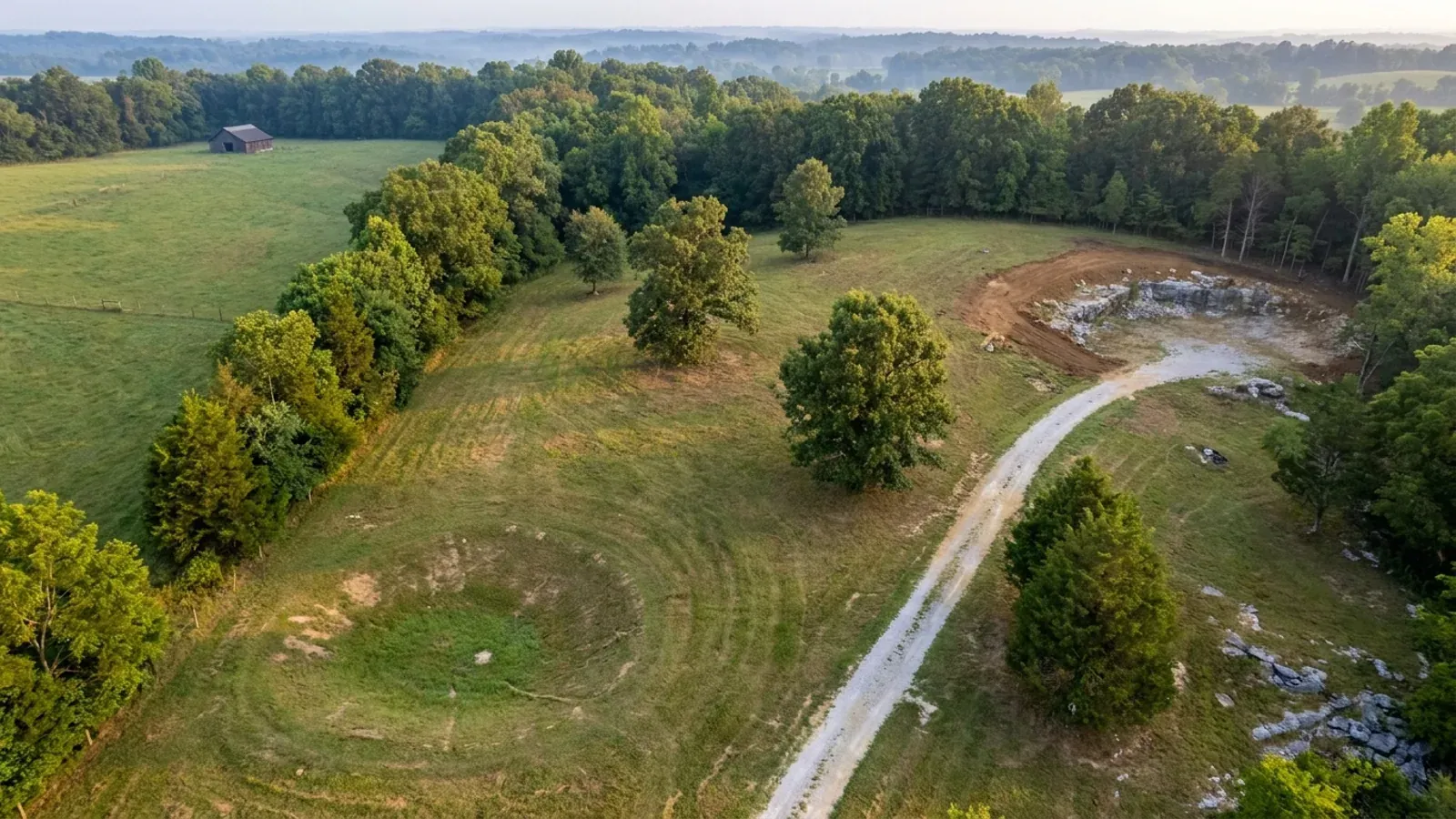
The parcel
Karst and mine maps, the flood question, zoning where the county has any, and utility access — all checked before anything is drawn.
Pad and permit
Clearing, grading and a compacted pad, while the submittal works through whichever office issues the permit — and where no office does, through the approvals that still apply.
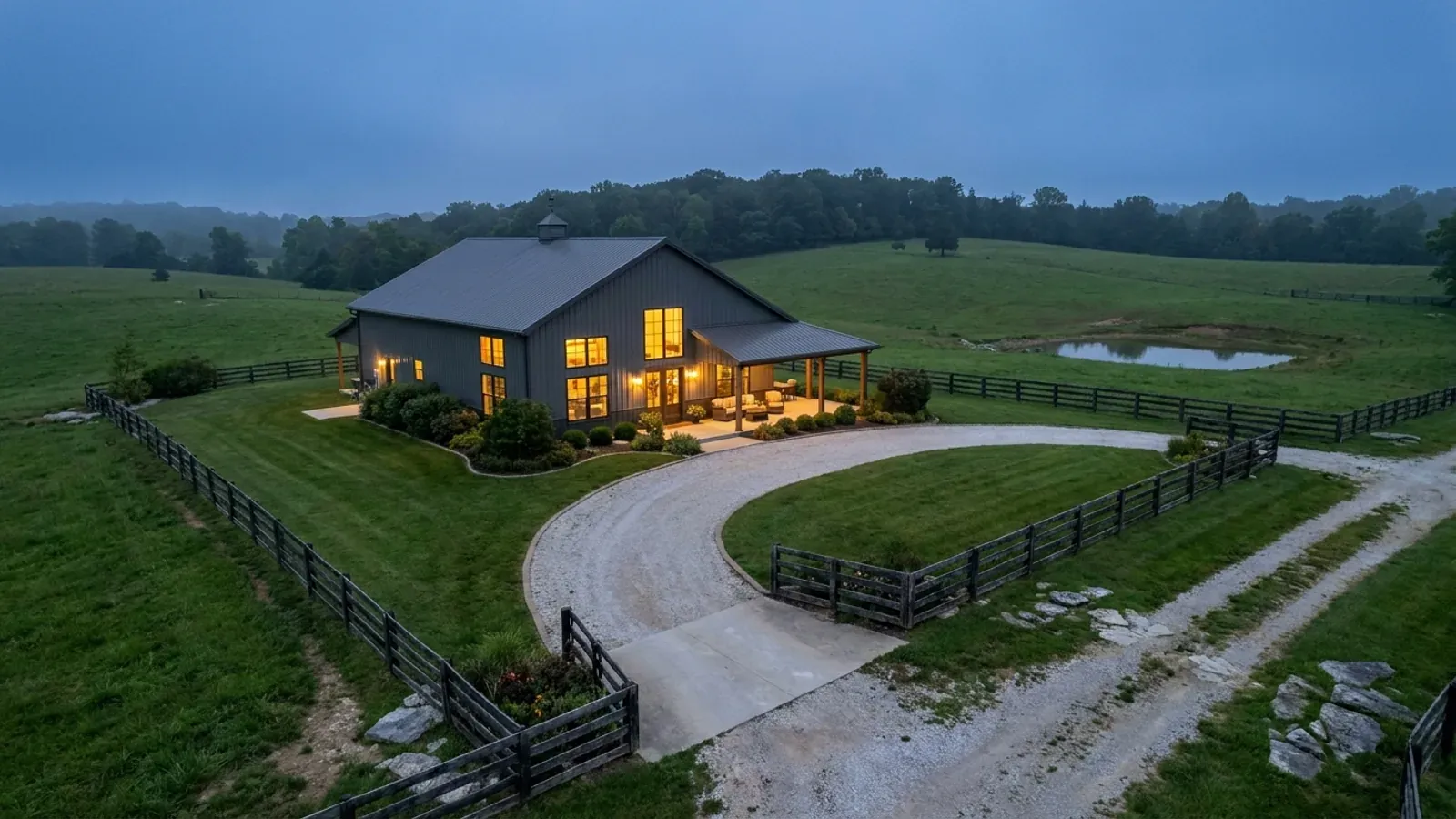
Frame to finish
Shell erected and dried in, then systems and interior finish — and the certified electrical inspection your utility needs before it will set a meter.
Those are the rules where you are building in Pulaski County. Tell us what you want to build and we will draw it to them.
Where we build around Pulaski County
Pulaski and the rural land around it. The buildable acreage for a project this size usually sits outside the city limits, and in Kentucky that line frequently decides whether anyone issues a permit at all, not merely who issues it.
Keep reading
The questions that usually come next once you know what Pulaski County allows.
Barndominium Cost Guide
Why the published spread runs from one end of the scale to the other, and which of it is the building rather than the ground.
Read itIs It Legal in Kentucky?
Whether your county inspects a house at all, what the farm-dwelling exemption really requires, and the approvals that reach you anyway.
Read itWhat a Pole Barn Home Costs
Post-frame against stick-built, and what the prescriptive post-frame section of the state code does and does not cover.
Read itNearby areas we build in
Others we cover nearby. They share the same statewide code and the same state-published design tables — but whether a house is permitted and inspected at all, whether the county zones, what the health department will accept for septic, and what the ground does to a foundation can all differ from one card to the next. Two counties that touch are not two versions of the same answer.
Building in Pulaski County: common questions
8 questions we get asked most often about building in Pulaski County. If yours is not on the list, ask it directly.
Do I need a building permit to put up a barndominium in Pulaski County?
If nobody inspects the structure, does anything actually get checked?
Can I build a shop bigger than the house?
Who issues the septic permit, and how much land do I need?
What design figures does a Pulaski County build have to meet?
Is Pulaski County a good place to actually find acreage?
What about radon and sinkholes here?
Do I need a contractor's licence to build in Somerset or Pulaski County?
Building in Pulaski County?
Start with the plan. Tell us what you want to build and we will draw it, then confirm whether any office permits and inspects a house where your parcel is, what it will let you put there, and which line of the state's snow, frost and seismic tables your county falls on. That conversation costs nothing.