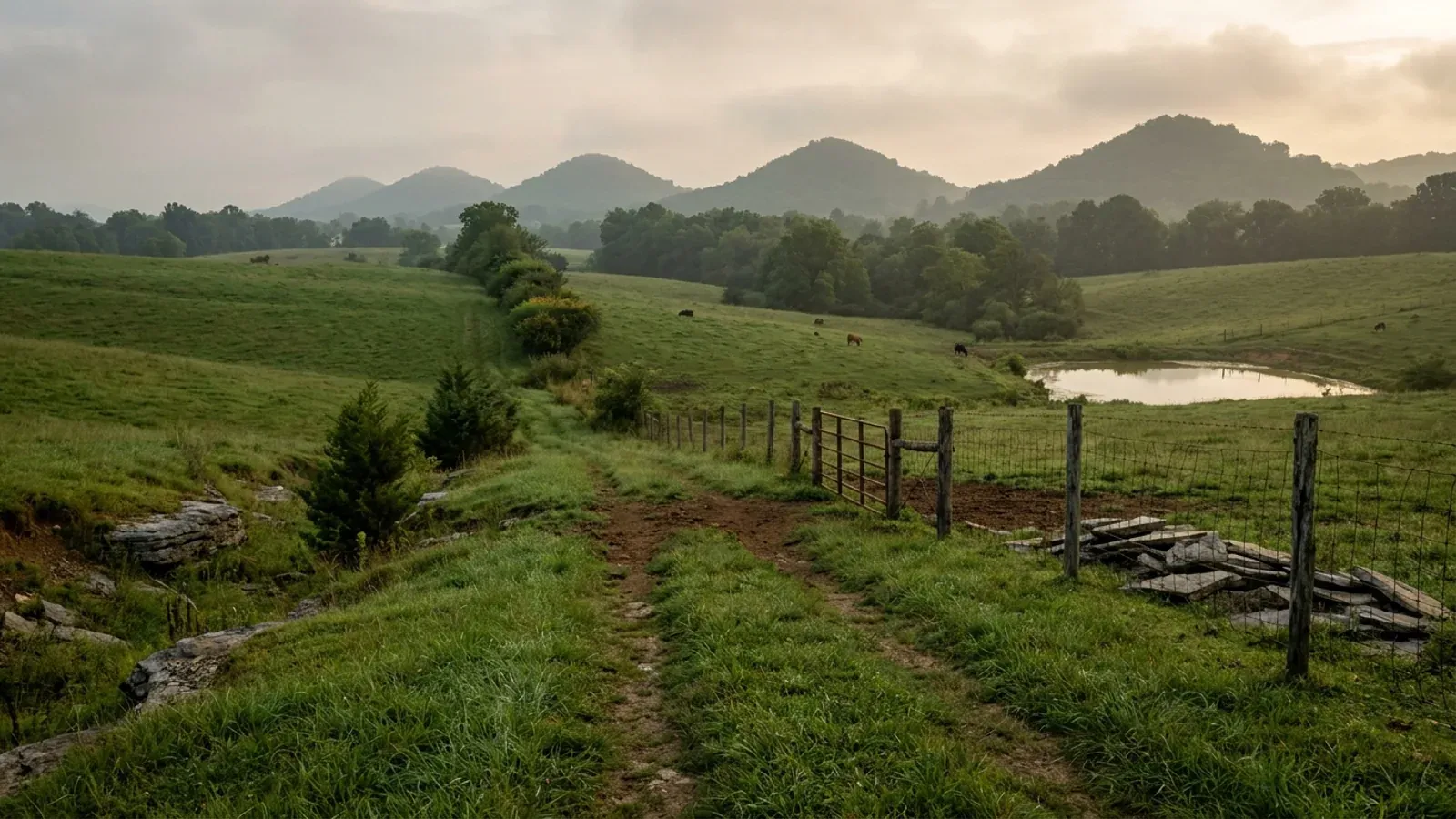
Barndominium Builders in Madison County, KY
Madison County is the exception to almost everything a buyer learns about permitting in the rest of Kentucky. In roughly eighty of the state's 120 counties there is no county zoning at all, and under KRS 198B.060(1) a single-family house on rural land needs no permit unless the local government passed an ordinance requiring one. Madison did both. Its Department of Planning and Development Services publishes that it is responsible for enforcement of the Kentucky Building and Residential Codes and the National Electric Code for new construction in Madison County excluding Richmond and Berea, and those two cities run building departments of their own — so all 441 square miles are covered by somebody, and there is no unregulated gap between the city lines to build in. The Land Development Code the Fiscal Court adopted on 12 September 2023 puts most rural land in the Agricultural district, where the minimum lot is five acres, or one acre where a single-family residence is the primary use, structures top out at forty feet, the front setback is fifty feet from a county road centreline, and an accessory building needs ten feet to the rear line. What that code does not contain anywhere is a cap on an accessory building's floor area against the dwelling's — a shop larger than the house clears the ordinance, provided it sits in the rear or side yard and the lot stays under fifty percent impervious. The ground is Outer Bluegrass limestone running south into the Knobs, with the Kentucky River gorge on the northern boundary, and the county's own code treats it accordingly: a 25-foot riparian buffer measured from the edge of a sinkhole, and any slope of thirty percent or more declared unsuitable for construction. USDA counts 1,164 farms here on 191,746 acres, and Madison is Kentucky's second-ranked county for cattle sales — but land in farms is down seventeen percent since the 2017 census, which is what the state's third-fastest county growth looks like in the agricultural statistics.
Madison County at a glance
- County
- Madison
- Population
- 103,792
- ZIP codes
- 40475, 40476, 40403, 40404, 40385, 40405
- Site visits
- Site visits up I-75 into Richmond, Berea, Waco and Kirksville
Building conditions in Madison County
The building code is the same in every Kentucky county, and no local government may adopt or enforce a different one on a house — the Kentucky Residential Code says so in its own text. The design criteria are settled by the state too: the code prints a filled-in table covering all 120 counties, so your county's ground snow load, frost depth and seismic design category are published figures rather than something a local office decides. Ultimate design wind speed is 115 mph for every county in the state.
What changes from one county to the next is whether anyone checks. Kentucky makes permits, inspections and certificates of occupancy optional for a single-family home unless the local government has passed an ordinance requiring them, and it forbids the state from stepping in where none has. Twenty-five counties tell the state outright that they have no local building inspector, and in much of the rest the answer depends on an ordinance the county either passed or never did. Zoning is a separate, equally local choice — most Kentucky counties have never adopted any. What is below covers this county specifically: who issues the permit if anyone does, what the state's tables assign it, and what the ground does to a slab.
https://madisoncountyky.gov/planning/ (department scope, read 6 Sep 2026) · https://madisoncountyky.gov/phocadownload/Planning/2018Forms/Building%20Construction%20Conditions%20Revised%2008-10-17.pdf (inspection sequence and certificate-of-occupancy language, PDF text extracted 6 Sep 2026) · https://dhbc.ky.gov/Documents/Madison%20County.pdf (DHBC sheet updated 9 Feb 2026) · https://apps.legislature.ky.gov/law/statutes/statute.aspx?id=52659
https://madisoncountyky.gov/download/land-development-subdivision-regulations/?wpdmdl=6440 — Madison County Land Development & Subdivision Regulations, adopted 9-12-2023, Article 3.05(a) Table 1: AG District Development Standards and Article 4.02(h) Accessory Buildings; PDF text extracted and read 6 Sep 2026 · https://madisoncountyky.gov/planning/applications-regulations/
https://madisoncountyky.gov/download/land-development-subdivision-regulations/?wpdmdl=6440 — Madison County Land Development Code, Article 3.05(a) Table 1 (minimum lot area), Article 5.05(b) and (c) (lot area and single building per lot), Article 5.17(a)(v) and (b)(iii) (rural residential development); PDF text extracted and read 6 Sep 2026
https://dhbc.ky.gov/Documents/2018%20Kentucky%20Residential%20Code%203d%20Ed.pdf — Table R301.2(1) (snow, wind, weathering, termite), Table R301.2.2.1 Seismic Design Categories–Site Class D, Table R403.1.4 Minimum Frost Protection Depth for Kentucky; transcribed in research/statewide/design-criteria-and-climate.md · https://madisoncountyky.gov/phocadownload/Planning/2018Forms/Building%20Construction%20Conditions%20Revised%2008-10-17.pdf (county footing-depth and adopted-codes text, extracted 6 Sep 2026)
https://madisoncountyky.gov/download/land-development-subdivision-regulations/?wpdmdl=6440 — Article 4.05(c)(iii)(D) and (d)(i) riparian buffers from sinkholes, Table 12 septic setbacks, Article 5.06(c)(ii) 30 percent slope; PDF extracted 6 Sep 2026 · https://pubs.usgs.gov/pp/p1151h/physiography.html (Outer Bluegrass and The Knobs) · https://www.uky.edu/KGS/water/library/gwatlas/wprkarst.html (KGS karst areas and the 92-of-120 count) · https://kgs.uky.edu/kygeode/geomap?gkarst=true (KGS Karst Potential Index, parcel-checkable) · https://radonlevels.org/state/ky (EPA zone by county) · https://www.epa.gov/sites/default/files/2014-08/documents/kentucky.pdf
https://www.nass.usda.gov/Publications/AgCensus/2022/Online_Resources/County_Profiles/Kentucky/cp21151.pdf (2022 Census of Agriculture, Madison County profile — PDF text extracted and read 6 Sep 2026) · https://madisoncountyky.gov/economic-development/agriculture/ · research/statewide/geography-and-population.md (441 sq mi at 210 people per sq mi; 92,701 to 103,792, +12.0 percent, 2010 to 2020)
Also worth knowing before you build in Madison County
- All three Madison County communities are in FEMA's Community Rating System, and Kentucky only has 33
- FEMA's Kentucky Community Status Book lists unincorporated Madison County (CID 210342B), the City of Richmond (210157B) and the City of Berea (210156B) as participating in the National Flood Insurance Program, all three on a current effective map dated 21 December 2017. Initial FIRMs run 18 September 1985 for Richmond, 30 September 1988 for Berea and 28 September 1990 for the county. What sets Madison apart is the Community Rating System columns: the county entered CRS on 1 May 2012 and holds Class 9 for a 5 percent premium discount, and Richmond and Berea both entered on 1 October 2015 and hold Class 8 for 10 percent. Kentucky has only 33 CRS communities in the whole book, and three of them are Madison County and its only two incorporated cities — every square foot of the county is inside a CRS community, which is not true of any other county in this service area. CRS class is a floodplain-management standard the community volunteered for, so it also signals that the local floodplain rules are stricter than the NFIP minimum. Madison County's floodplain manager is Austin Bates, who also serves as GIS Coordinator, at 135 W Irvine Street. On top of any local approval, Kentucky requires a separate state Division of Water floodplain permit for construction in the base floodplain under KRS 151.250 and 401 KAR 4:060 §2, applied for on form DOW 7116 — the state permit stacks on the local one rather than replacing it, and the Kentucky River corridor along the county's northern boundary is where that most often bites.
- The septic permit comes from a single-county health department, not a district — and it costs $600 before anyone digs
- Most Kentucky counties are served by a multi-county district health department. Madison is not: the Madison County Health Department at 216 Boggs Lane in Richmond, 859-623-7312, serves this county alone, and its environmental office is where the on-site sewage work is done. The department publishes the sequence and the money. Before buying a lot, contact the health department for a site evaluation to determine the suitability of the soil for an on-site sewage system — the site evaluation fee is $250. Once the soil evaluation is approved and the system type is determined, the certified installer or the homeowner obtains the sewage permit, but not before the proposed system design is laid out on site by the certified installer and inspected by the certified inspector; the sewage permit is a further $350. The department states plainly that the system must be installed, inspected and approved before the local building inspector will issue a certificate for occupancy, and that state plumbing regulations require the sewage permit before the inside plumbing permit can be issued, with both in hand before Madison County Utilities will set a water meter. Environmentalist office hours are 8:00 to 9:30 a.m., Monday to Friday, which is a narrow window to plan a call around. The plumbing inspector, Isaac Clark on 859-302-4135, is a separate person from the environmental office and cannot be reached on its number.
- The county publishes its permit fees, and the penalty for starting without one is that they double
- Madison County's fee schedule, effective 14 November 2023, prices the building permit on estimated construction cost: $50 up to $2,000; $50 for the first $2,000 plus $5 for each additional thousand up to $15,000; $104 for the first $15,000 plus $4 per additional thousand to $50,000; $244 for the first $50,000 plus $3.50 per thousand to $100,000; $380 for the first $100,000 plus $2.25 per thousand to $500,000; and $1,280 for the first $500,000 plus $1.75 per thousand above that. The certificate of occupancy is $30 and there is a $50 minimum permit fee. Two lines are worth knowing before you start work. First, the penalty: if a building construction project is started without first obtaining a building permit, the building permit fee shall be doubled — and if the building inspector thinks the stated valuation is understated, the permit is denied until the owner or contractor can verify the projected costs. Second, the plan review table prices review per square foot by occupancy and its residential line reads residential excluding one- and two-family, so a single-family dwelling is not carrying a per-square-foot review charge on this schedule. Electrical is $175 per service for a 200-amp single-family service including temporary service and all inspections, $225 at 400 amps and $325 at 600 amps or larger, with barns and garages at $100 per permit for a single trip or $150 where multiple inspections are needed. Mechanical is $105 for the first system plus $50 for each additional system in a one- or two-family dwelling.
- You may legally live in an RV on the site while the house goes up
- Article 4.02(j) of the Land Development Code prohibits temporary or permanent human occupancy of a recreational vehicle, travel trailer, camper, coach, motorised dwelling or tent trailer — with two written exceptions. The first is occasional overnight use by a visitor. The second is that where the occupants are constructing a permanent residence on the same site, the vehicle may be used for temporary residency during construction. That is an unusually explicit permission and it answers a question owner-builders ask constantly, because in a great many jurisdictions the same arrangement is tolerated informally and can be shut down on a complaint. The same article requires that such a vehicle not be parked or stored so as to encroach across lot lines or into a right-of-way including sidewalks, and that it be properly registered and display a current licence where required by law. This is a county-district rule and does not reach inside Richmond or Berea, each of which has its own ordinance. It also does not answer the separate question of sanitation while camped, which runs back to the health department and the septic permit.
- The zoning farm exemption is five acres; the building-code farm exemption is ten
- Two different Kentucky exemptions get merged in conversation and they carry different thresholds, so it is worth separating them before anyone plans a build around either. On the zoning side, Madison County's code carries the KRS Chapter 100 exemption verbatim: land used solely for agricultural use as defined in KRS 100.203(4), and established prior to any local zoning regulations that regulate such use, has no regulations imposed as to building permits, certificates of occupancy, height, yard or location requirements for agricultural buildings — except that setback lines may still be required to protect existing and proposed streets and highways, and buildings in a designated floodway or floodplain, or which tend to increase flood heights or obstruct flood flows, may be fully regulated. The code's own definition of agricultural use, taken from KRS 100.111, turns on a tract of at least five contiguous acres. The building-code exemption under KRS Chapter 198B is a separate instrument with a different test, reaching a farm dwelling only on a PVA-registered farm of ten contiguous acres outside city limits. Neither is a licence to skip the house: the zoning exemption is written for agricultural buildings, the KRS 100.111 definition excludes residential building development for sale or lease to the public, and KRS 100.203(4)(c) keeps zoning's reach over the dwelling. If you intend to rely on either, get it in writing from the office before the concrete is ordered.
- Richmond–Berea is a micropolitan area, not a metro — and Madison is not a mine-subsidence county
- Two labels that get applied to this market incorrectly. Richmond–Berea is a micropolitan statistical area, not a metropolitan one: the µSA covers Madison, Rockcastle and Estill counties for a combined 131,806 people, and it was redelineated out of metropolitan status rather than into it. Calling Richmond a metro overstates the market and misdescribes the geography, which is one county of real population plus two rural neighbours. Second, Madison is not among the 37 counties in the Kentucky Mine Subsidence Insurance Fund — that list maps the eastern and western coal fields, and Madison sits between them alongside Garrard, Rockcastle and Estill, none of which are on it either. Where a county has voted the coverage in, KRS 304.44-030 puts the mine-subsidence endorsement on every property policy automatically unless the insured waives it in writing; in Madison there is no such endorsement to waive because there is no coal to subside. That is worth saying precisely, because the hazards get merged and they are not the same. The ground risk here is limestone solution and steep slopes, and Kentucky built no statutory fund, no mandatory endorsement and no seller-disclosure question for either — the Kentucky Real Estate Commission's Form 402 asks about soil stability, drainage and erosion and asks nothing about sinkholes, caves or undermining.
- Every parcel in the county is inside somebody's zoning map, and the district decides the answer
- Because Madison County adopted planning and zoning under KRS Chapter 100 and both of its cities have their own ordinances, there is no unzoned rural remainder here of the kind that covers most of Kentucky. The county's own districts are AG, SF-LD, SF-MD, MF-MD, MF-HD, MH, NB, GB, LI, HI, RE, PSP and PUD, plus an Urban Corridor overlay, and the controlling document is the Official Land Use Management Map of Madison County, signed by the County Judge Executive and attested by the County Clerk. The two residential districts are much tighter than AG on the questions that matter to this building type: SF-LD takes a 21,780 square foot lot on sewer or one acre without it, SF-MD requires public water and public sewer and takes 12,000 square feet, and SF-MD additionally requires the lot to be within five road miles of the fire station serving it. Both still allow 40 feet of height and a 10-foot accessory rear setback, but SF-LD caps impervious coverage at 40 percent rather than AG's 50, which is the constraint a large shop plus a drive hits first. So the first question on any Madison parcel is not what the code says, it is which district the parcel is in and whether it is inside a city line — and the second is what the recorded plat and any subdivision covenant say, because a private covenant can forbid what the ordinance permits.
https://www.fema.gov/cis/KY.html (Kentucky Community Status Book — raw HTML retrieved and the CID, FIRM, CRS entry, class and discount columns read directly, 6 Sep 2026) · https://madisoncountyky.gov/information-technology/floodplain/ · https://apps.legislature.ky.gov/law/statutes/statute.aspx?id=54097 · https://apps.legislature.ky.gov/law/kar/titles/401/004/060/ · https://eec.ky.gov/Environmental-Protection/Water/FloodDrought/Pages/default.aspx
https://madisoncountyhealthdept.net/Permits.html (Guidelines for Sewage, Plumbing and Building Permits — read 6 Sep 2026; the department's .org host returns a Cloudflare SSL error 525 to automated requests, so the .net copy of the same site was used) · https://dhbc.ky.gov/Documents/Madison%20County.pdf (health department address and environmental phone, sheet updated 9 Feb 2026) · https://apps.legislature.ky.gov/law/kar/titles/902/010/085/
https://madisoncountyky.gov/phocadownload/Planning/FEE.SCHEDULE.2023.pdf (Madison County Planning and Development Fee Schedule, effective 14 November 2023 — PDF text extracted and read 6 Sep 2026) · https://madisoncountyky.gov/planning/fee-structure/
https://madisoncountyky.gov/download/land-development-subdivision-regulations/?wpdmdl=6440 — Madison County Land Development Code, Article 4.02(j) Parking and Storage of Recreational Vehicles; PDF text extracted and read 6 Sep 2026
https://madisoncountyky.gov/download/land-development-subdivision-regulations/?wpdmdl=6440 — Article 2.02(c)(i) Land Use Exceptions: Agricultural Uses, and Article 7.02 definition of Agricultural Use; PDF text extracted and read 6 Sep 2026 · https://apps.legislature.ky.gov/law/statutes/statute.aspx?id=46635 (KRS 100.111) · https://apps.legislature.ky.gov/law/statutes/chapter.aspx?id=38316
research/statewide/geography-and-population.md (Richmond–Berea µSA composition and the 131,806 figure; corrected from an earlier metropolitan reading) · https://insurance.ky.gov/PPC/Documents/JAN%202025_Revised%20Mine%20Subsidence%20Insurance%20Fund%20080124.pdf (the 37 participating counties) · https://insurance.ky.gov/ppc/Documents/bulletin0904minesubs092109.pdf · https://krec.ky.gov/Documents/KREC%20Form%20402%20-%20Sellers%20Disclosure%20of%20Property%20Condition.pdf
https://madisoncountyky.gov/download/land-development-subdivision-regulations/?wpdmdl=6440 — Article 3.02 Zoning Districts Established, Article 3.03 Official Zoning Map, Article 3.05(b) Table 2 Residential Districts Development Standards; PDF text extracted and read 6 Sep 2026 · https://geohub-madisoncountyky.opendata.arcgis.com/maps/f897f96e8d024787ba672d7dcdc5a60e (county zoning layer) · https://bereaky.gov/wp-content/uploads/2024/08/2018-Land-Management-and-Development-Ordinance-Amended-AUG-2024.pdf (City of Berea's separate ordinance)
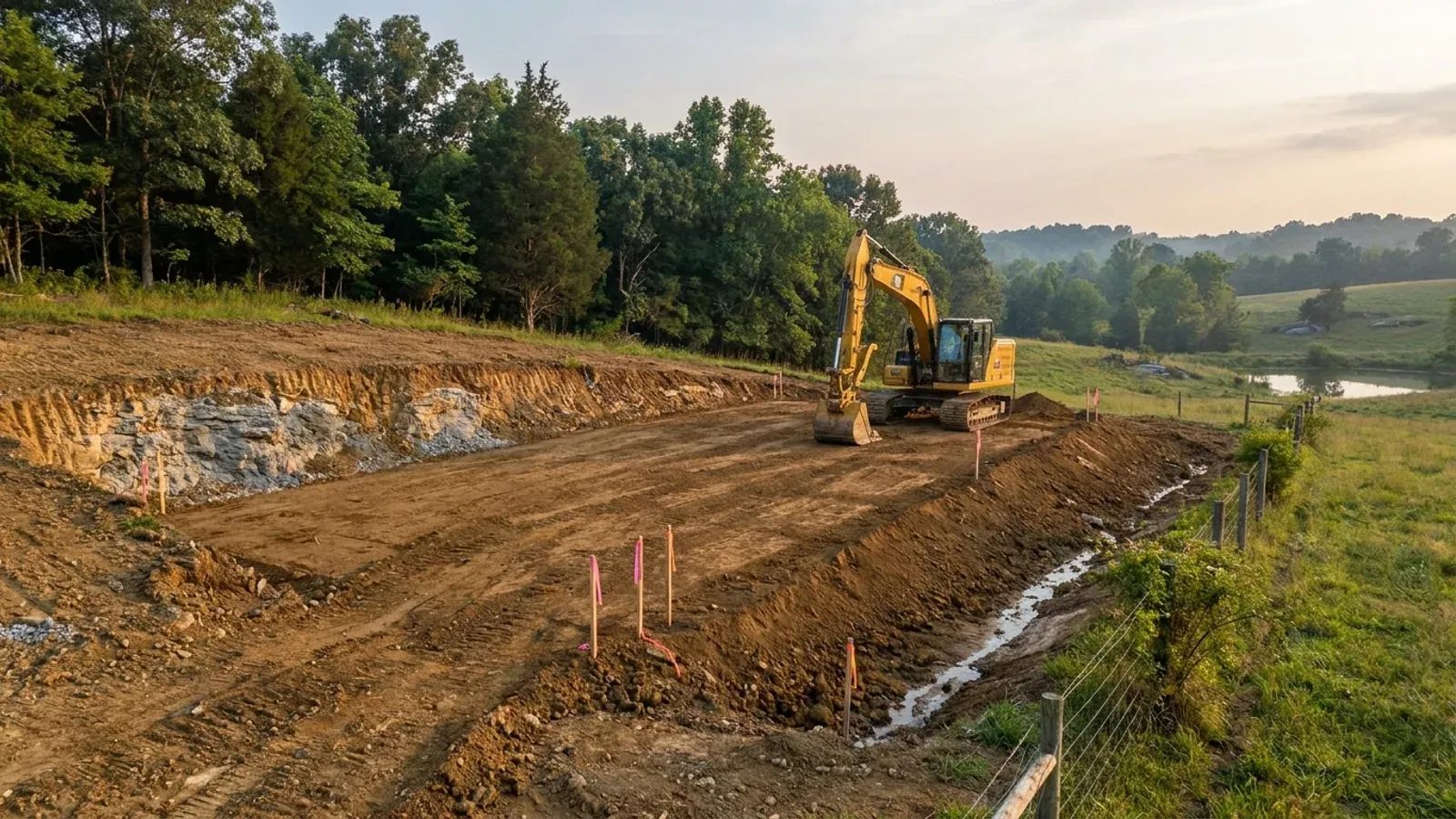
The expensive surprises are in the ground, not the building
What moves a Kentucky budget is usually below grade, and more often than not it is what the ground is sitting on rather than the ground itself. The Kentucky Geological Survey says 92 of the state's 120 counties contain karst — limestone that dissolves — across four named areas: the Western Pennyroyal around Bowling Green and Hopkinsville, the Inner Bluegrass around Lexington, the Eastern Pennyroyal through Somerset and Monticello, and Pine Mountain in the south-east. On karst, KGS's own model ordinance for local governments lists the structures that should not be sited in sinkhole areas, and the list is buildings with soil-bearing foundations and buildings that cover thousands of square feet with impermeable surface. A post-frame or steel building on a monolithic slab is both of those at once. KGS is equally clear that nearly all karst parcels still have buildable ground on them — so karst does not stop the build, it removes the option of siting the pad by eye. A filled and graded-over sinkhole is the classic trap, because the pad looks perfect.
In the two coal fields the question is undermining instead, and Kentucky treats it differently from everything else: mine subsidence coverage is added automatically to property policies in the counties whose fiscal court voted the fund in, with a written opt-out — thirty-seven of them — while karst collapse gets no fund at all and falls under the ordinary earth-movement exclusion. On slopes the surprise is geographic: KGS's landslide inventory puts Kenton, Campbell, Boone and Gallatin — the northern Kentucky counties opposite Cincinnati — near the very top, above most Appalachian counties, on Ordovician shale. Three of those four — Boone, Campbell and Kenton — are the only counties in the state with a line of their own in the residential code's bearing table, which raises the presumptive value for two named clay groups there and nowhere else. Everywhere else the table gives clay and silt a single presumptive figure, and a soils investigation becomes mandatory once the building official determines the real capacity is likely to be lower than it.
The same ground then sizes the septic system, and Kentucky does that from soil morphology — a certified inspector reading the profile in a backhoe pit — rather than from a percolation test, at 110 gallons a day per bedroom against an application rate taken from soil texture and structure. On a mound or other alternative design a measured permeability test can still be required. And on karst the septic regulation is blunter than the building code ever gets: it declares the ground within seventy feet of an open sinkhole throat unsuitable outright. The soil that needs a foundation engineer is usually the soil that complicates the drainfield, so the site work, the foundation and the septic get resolved together rather than one at a time. We price the dirt before we price the building.
What we build in Madison County
All seven services are available in Madison County. What a build costs depends far more on the parcel than on square footage, so we price against your land rather than publishing a rate card.
Barndominium Kits
We check barndominium kit packages against the wind, snow, frost and seismic criteria the Kentucky Residential Code publishes for your county.
Pole Barn Homes
Pole barn homes across Kentucky. KRC §R327 covers accessory barns, not houses — so a pole barn home is engineered by the code's own terms.
Custom Barndominium Plans
Barndominium plans drawn to Kentucky's published county design criteria — snow, wind, seismic, frost — with engineering where the code calls for it.
What a build looks like
Three stages every Madison County project passes through, from a raw parcel to a finished home. Site work first, because that is where the budget is decided.
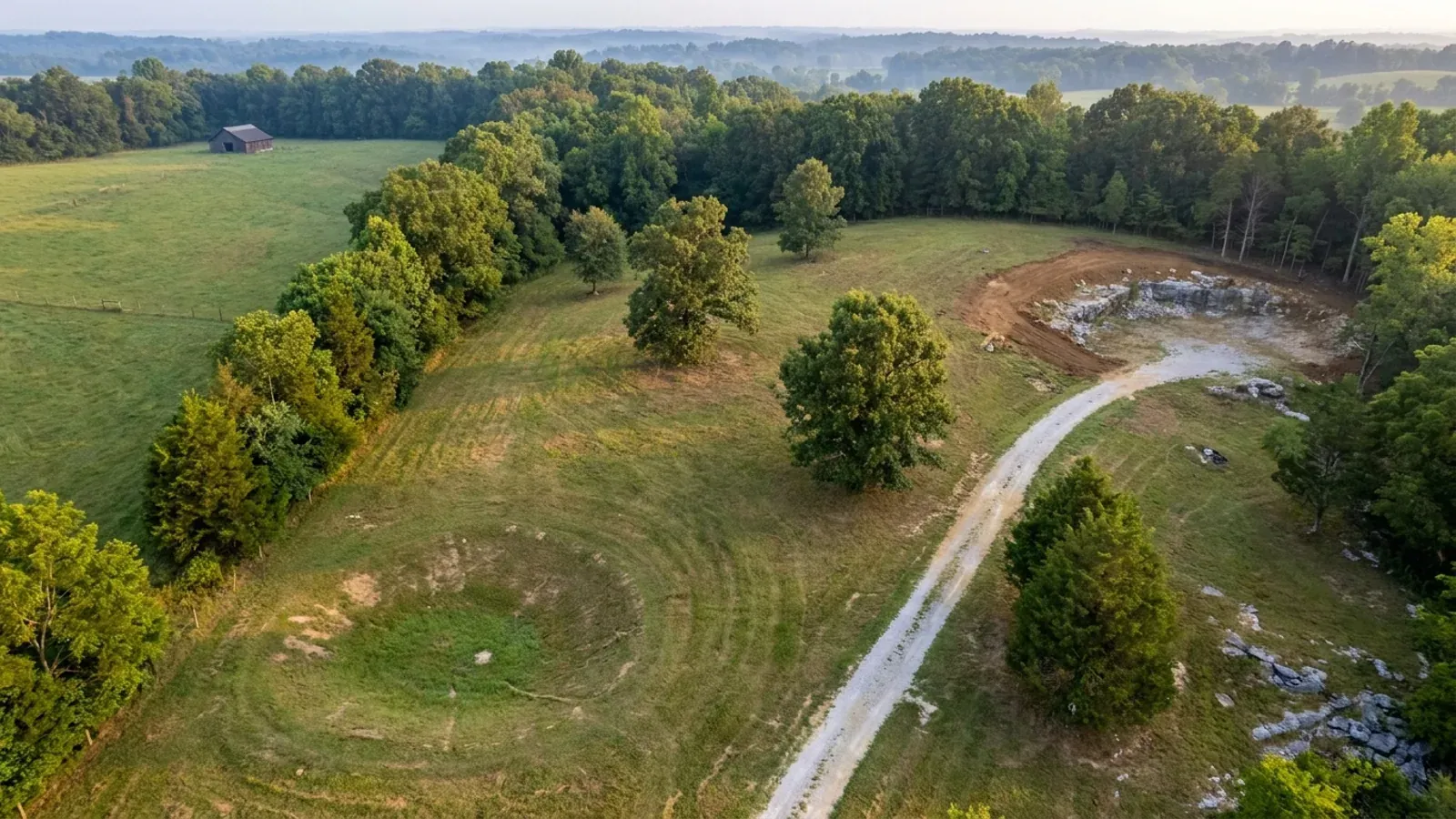
The parcel
Karst and mine maps, the flood question, zoning where the county has any, and utility access — all checked before anything is drawn.
Pad and permit
Clearing, grading and a compacted pad, while the submittal works through whichever office issues the permit — and where no office does, through the approvals that still apply.
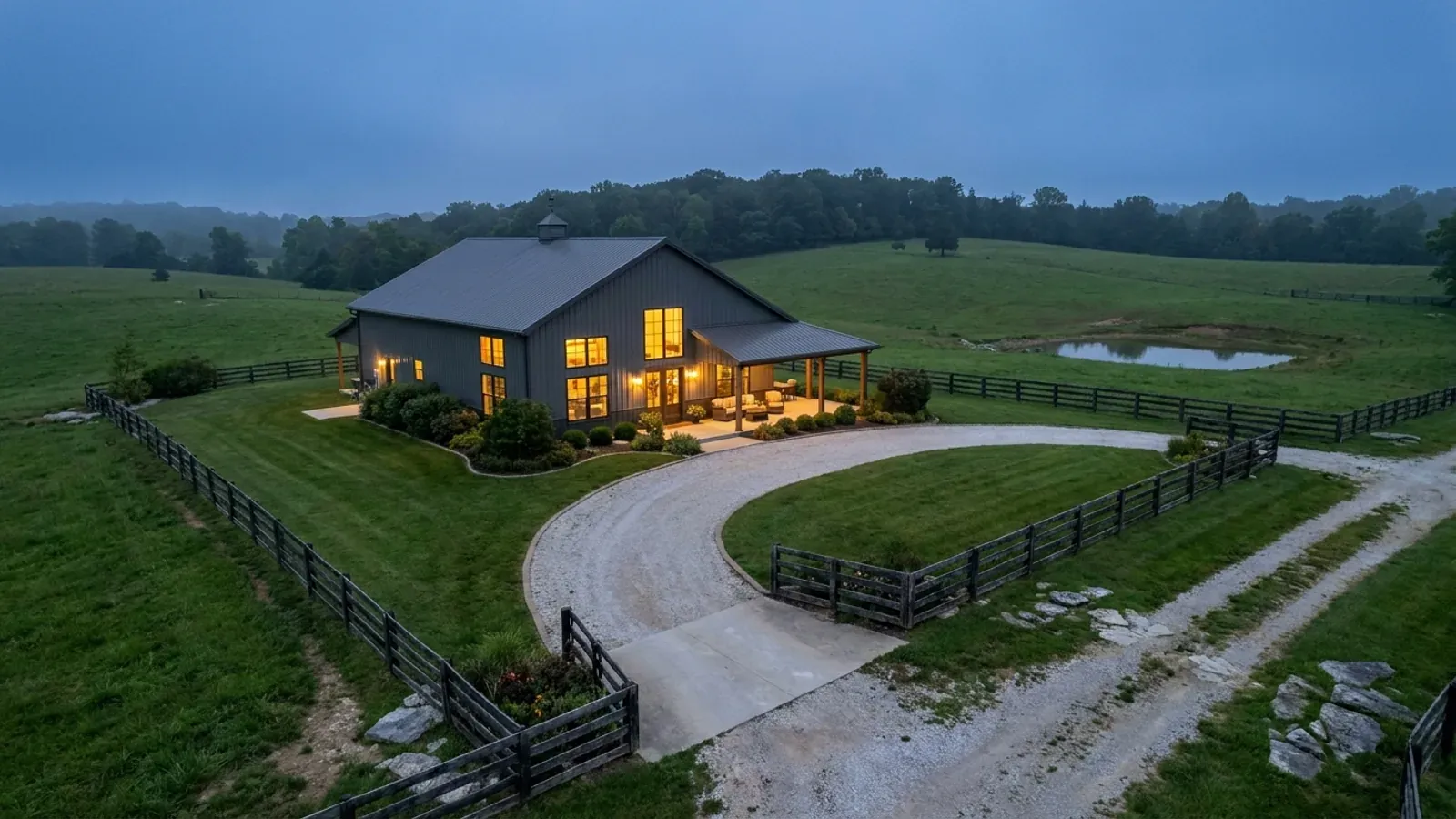
Frame to finish
Shell erected and dried in, then systems and interior finish — and the certified electrical inspection your utility needs before it will set a meter.
Those are the rules where you are building in Madison County. Tell us what you want to build and we will draw it to them.
Where we build around Madison County
Madison and the rural land around it. The buildable acreage for a project this size usually sits outside the city limits, and in Kentucky that line frequently decides whether anyone issues a permit at all, not merely who issues it.
Keep reading
The questions that usually come next once you know what Madison County allows.
Barndominium Cost Guide
Why the published spread runs from one end of the scale to the other, and which of it is the building rather than the ground.
Read itIs It Legal in Kentucky?
Whether your county inspects a house at all, what the farm-dwelling exemption really requires, and the approvals that reach you anyway.
Read itWhat a Pole Barn Home Costs
Post-frame against stick-built, and what the prescriptive post-frame section of the state code does and does not cover.
Read itNearby areas we build in
Others we cover nearby. They share the same statewide code and the same state-published design tables — but whether a house is permitted and inspected at all, whether the county zones, what the health department will accept for septic, and what the ground does to a foundation can all differ from one card to the next. Two counties that touch are not two versions of the same answer.
Building in Madison County: common questions
8 questions we get asked most often about building in Madison County. If yours is not on the list, ask it directly.
Do I need a building permit for a barndominium in Madison County?
Can I build a shop bigger than the house here?
How much land do I need, and what will the health department want?
What structural design figures does a Madison County build have to meet?
Is there still buildable acreage in Madison County?
What about sinkholes, slopes and flooding here?
Does the farm exemption let me skip the permit?
Do I need a contractor's licence to build in Madison County?
Building in Madison County?
Start with the plan. Tell us what you want to build and we will draw it, then confirm whether any office permits and inspects a house where your parcel is, what it will let you put there, and which line of the state's snow, frost and seismic tables your county falls on. That conversation costs nothing.